
Medical Writing
Samples and examples
The first part shows our deliverable layouts and main statistical figure formats; the second shows ways of presenting public research. Neither contains client information. Public research examples: Not a Yanto Health project.
Layout samples illustrate document structures. Statistical figures labelled Illustrative data do not represent real study findings. Reproductions of public data and figures redrawn from published literature retain their sources, data classification and interpretive limits.
No samples match the current filters.
Currently showing samples
01Medical Writing
Eight scientific slide types
Standard layout templates retain blank placeholders and accompany the slide template. Samples use neutral greyscale; deliverables are coloured to the client's visual guidelines. Slide type names and structures remain the same across colour schemes.
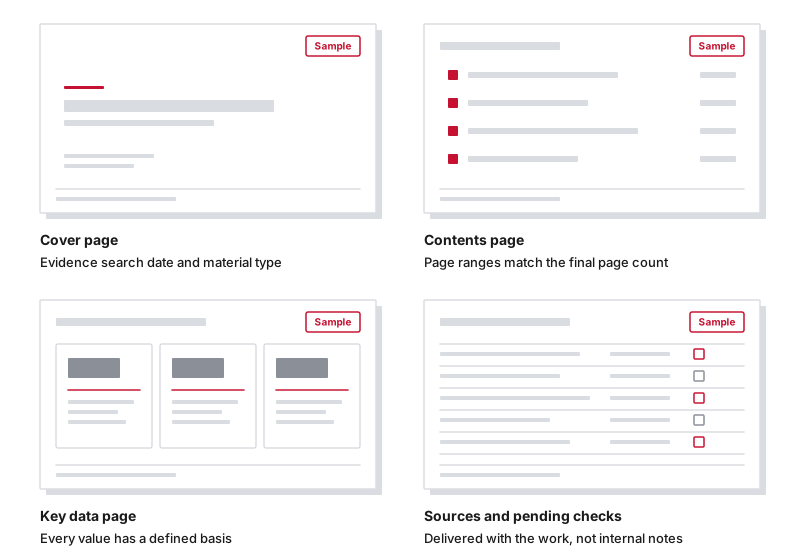
Figure caption
Standard layout templates retain blank placeholders and accompany the slide template. Samples use neutral greyscale; deliverables are coloured to the client's visual guidelines. Slide type names and structures remain the same across colour schemes.
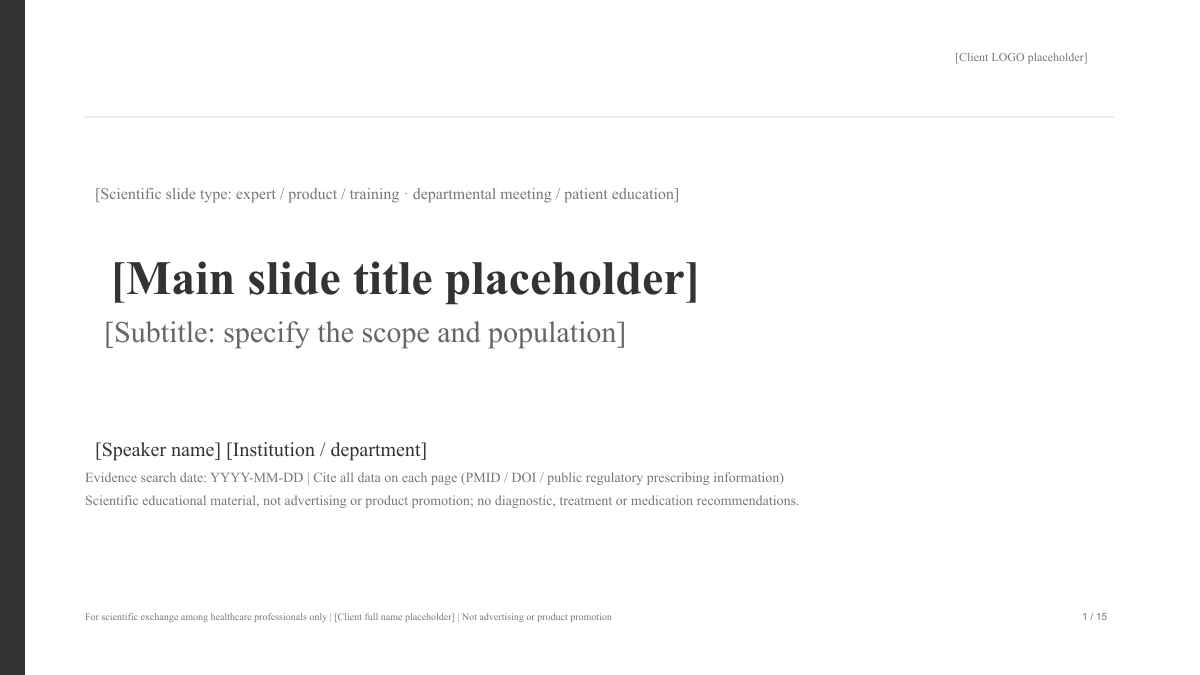
Figure caption
Records the evidence search date and material classification.
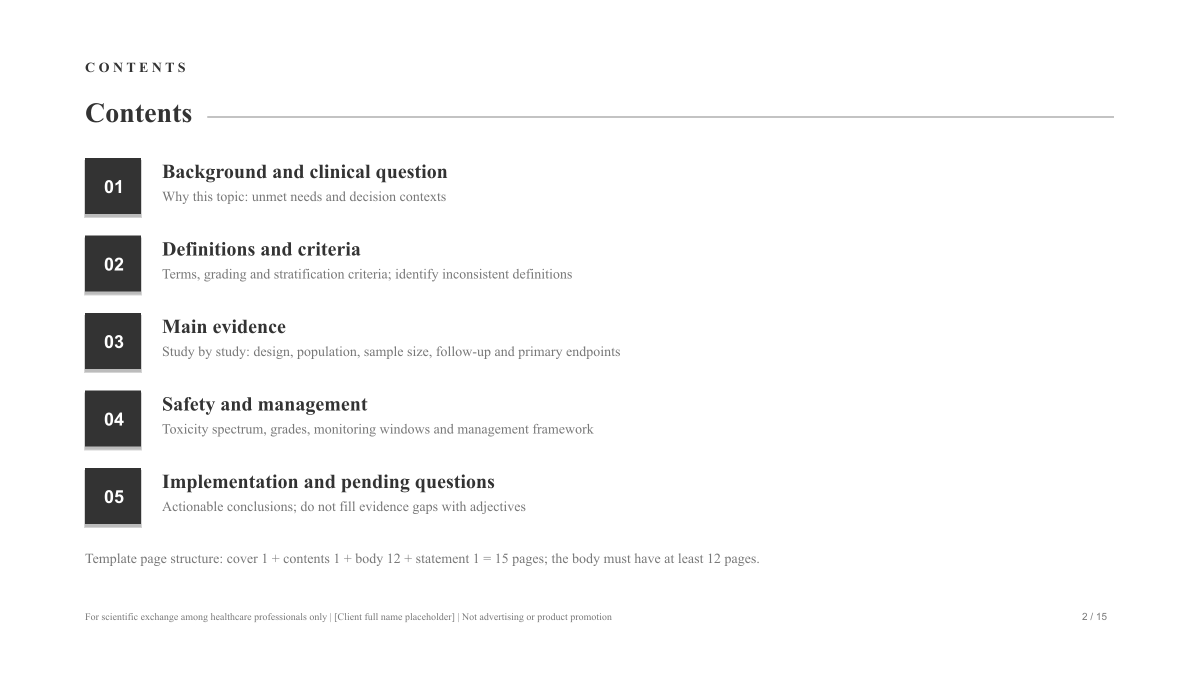
Figure caption
Section page references match the final slide count.
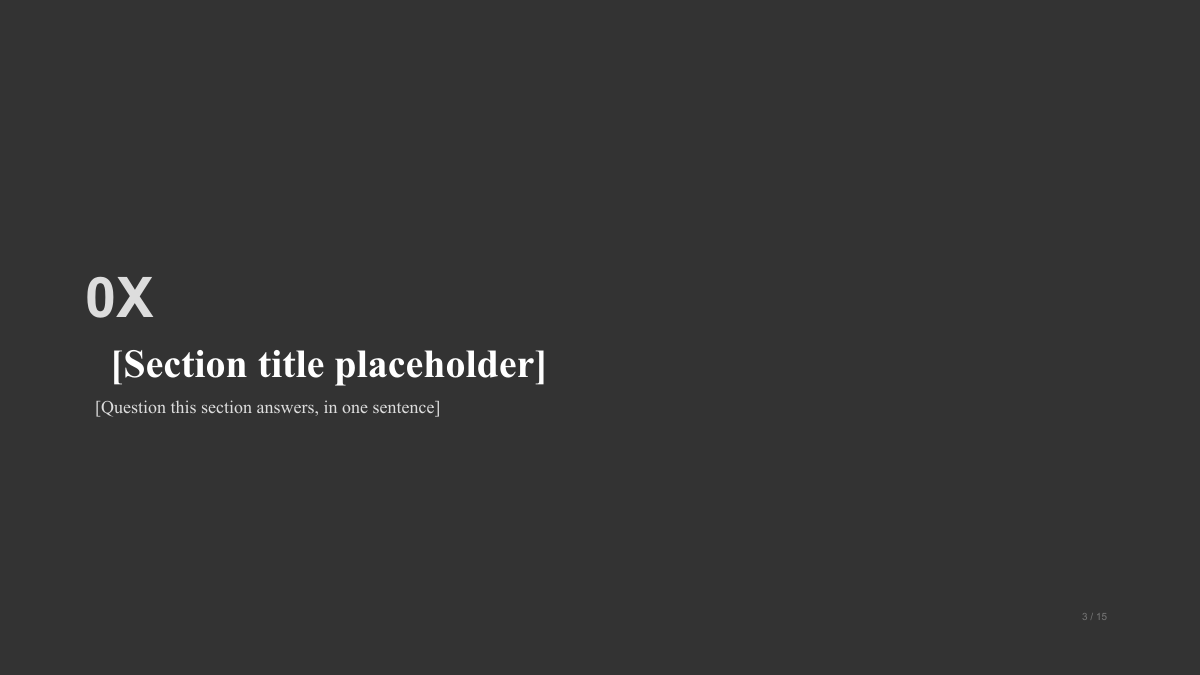
Figure caption
Excluded from the billable slide count.
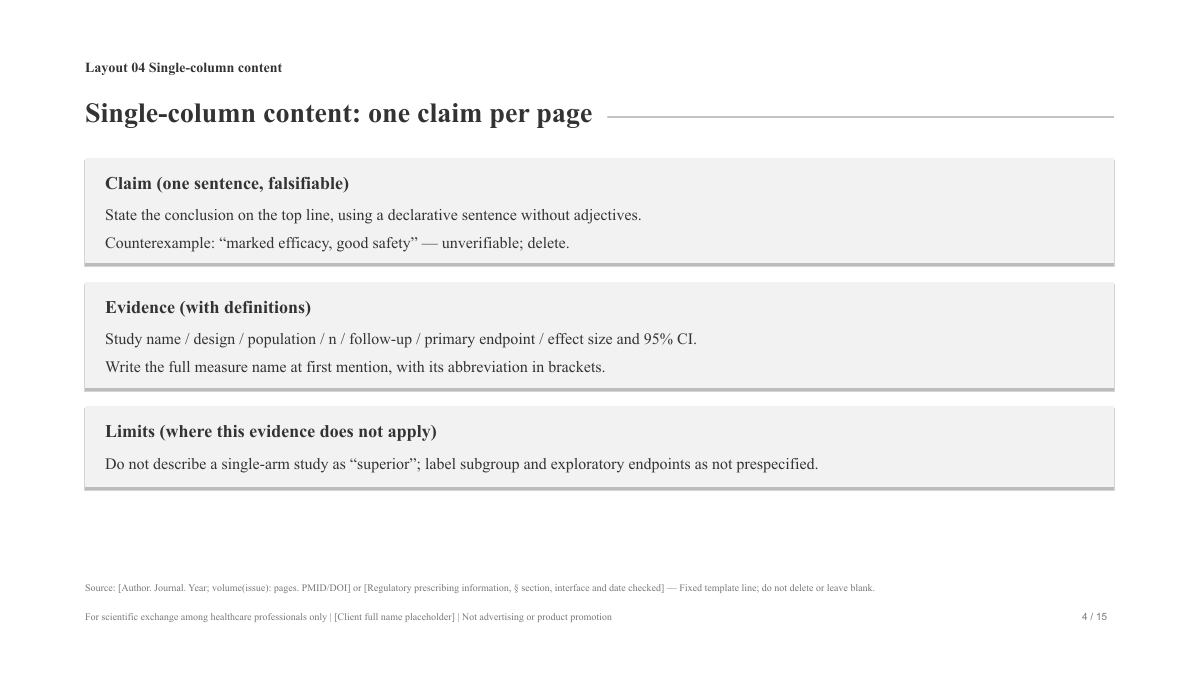
Figure caption
A source footnote appears on every slide; the sample content presents our writing rules.
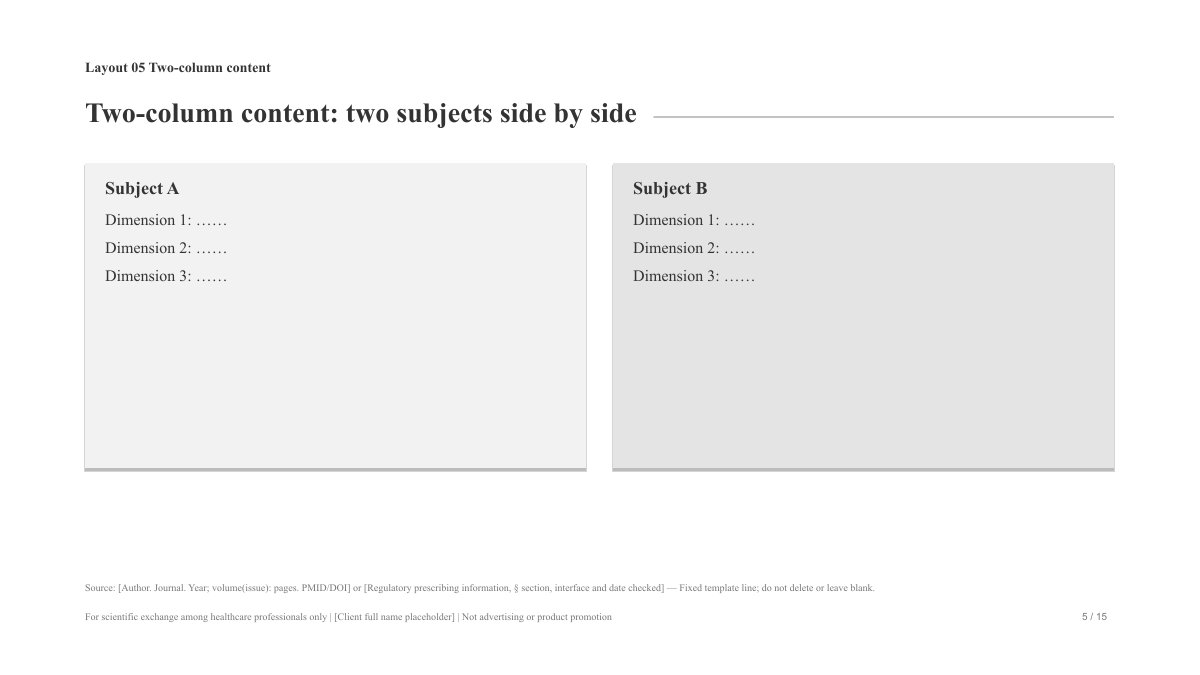
Figure caption
For comparisons and parallel information.
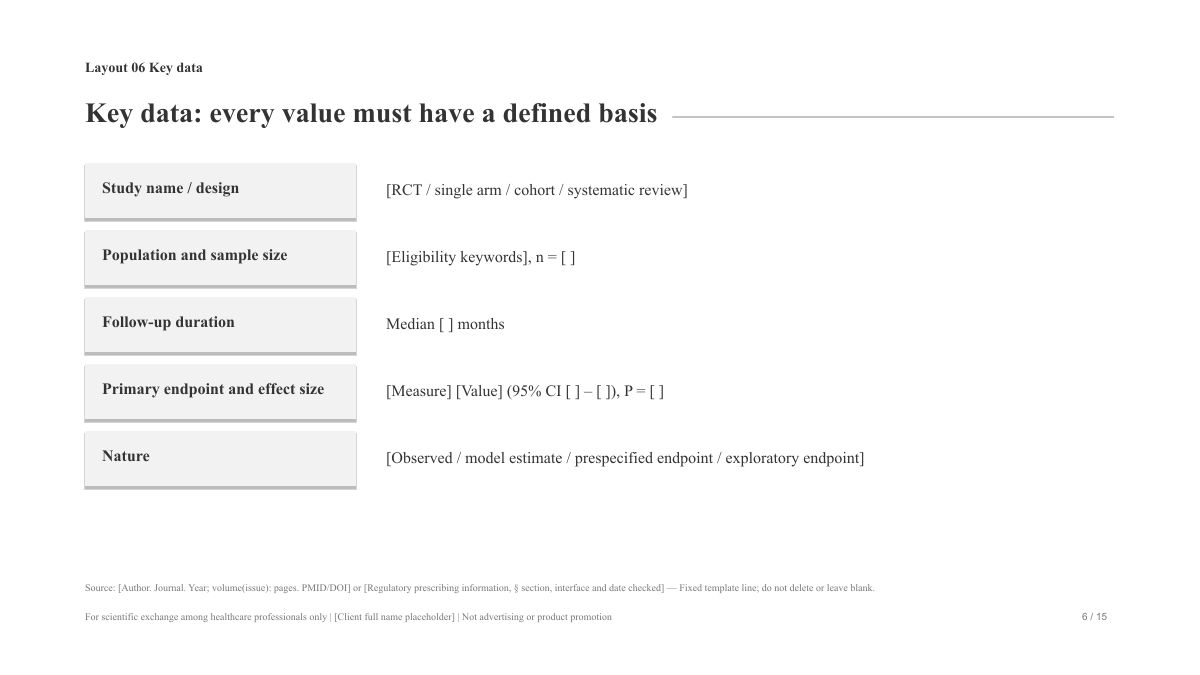
Figure caption
Every value is linked to its definition.
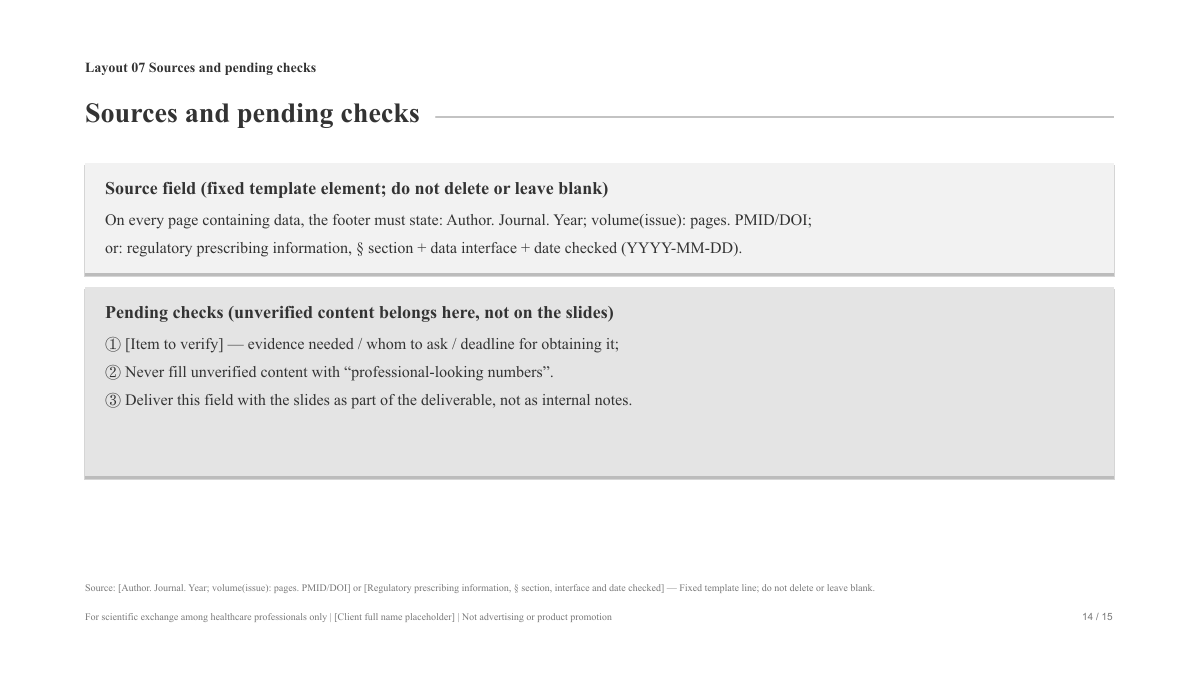
Figure caption
Delivered with the document, not retained as internal notes.
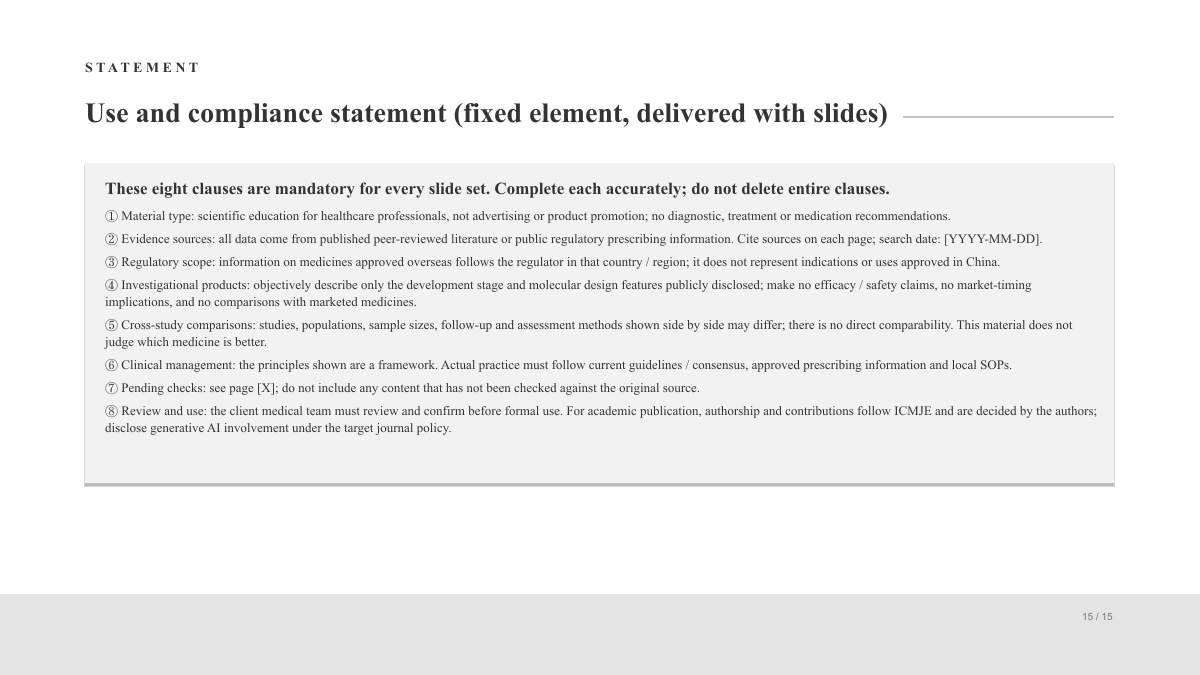
Figure caption
Compliance statements and disclosure of involvement.
02Medical Writing
Data definitions and items to verify
Enlarged details of the key data slide and the sources and verification slide.
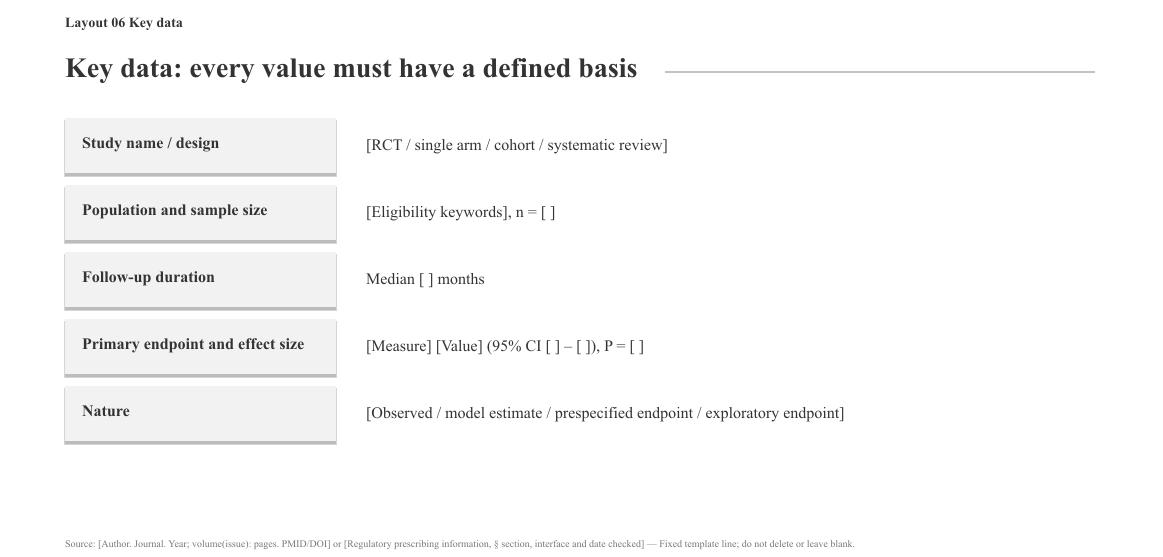
Figure caption
Each value is accompanied by the study name and design, population and sample size, follow-up duration, effect size and confidence interval. It is identified as observed, model-estimated, a prespecified endpoint or an exploratory endpoint.
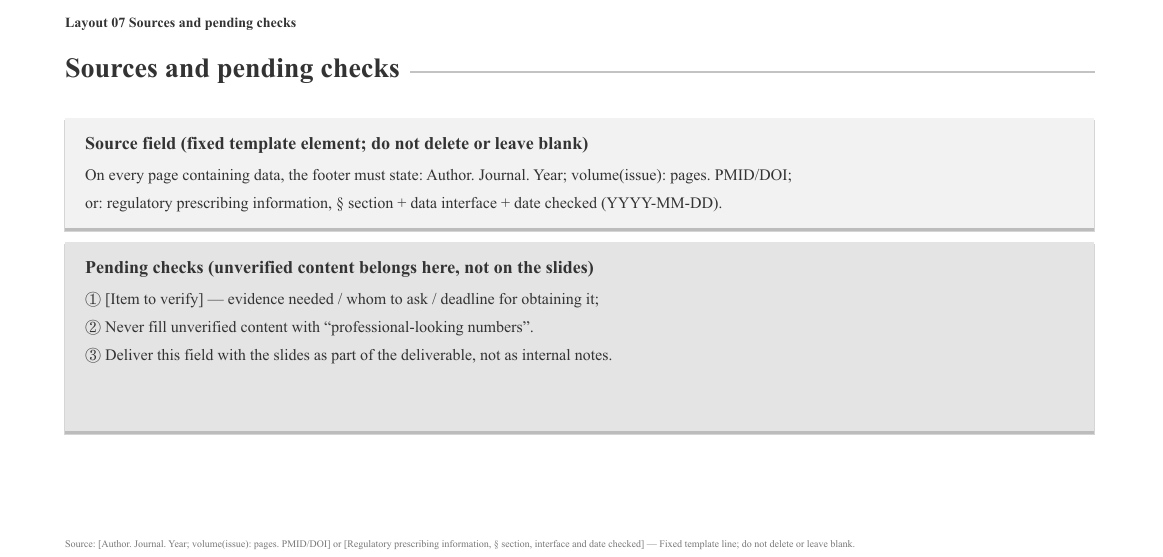
Figure caption
Each item awaiting verification specifies the evidence needed and the deadline for obtaining it. Unverified content is not replaced by numbers without stated sources.
03Medical Writing
Document structure samples
These samples show how contents, chapters and record tables are organised; they are not client project documents. See the standards reference for the standards underpinning the clinical study report (CSR) and common technical document (CTD) samples.
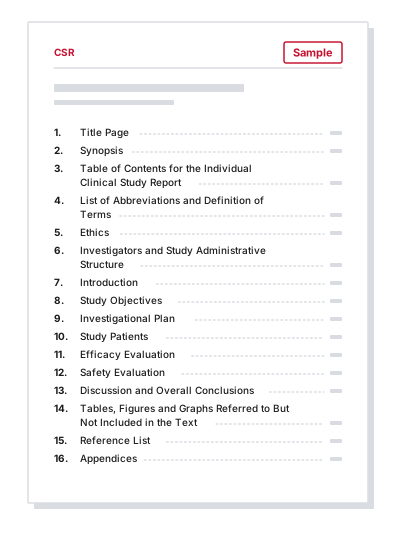
Figure caption
Shows the chapter organisation of a CSR for comparison with the document structure.
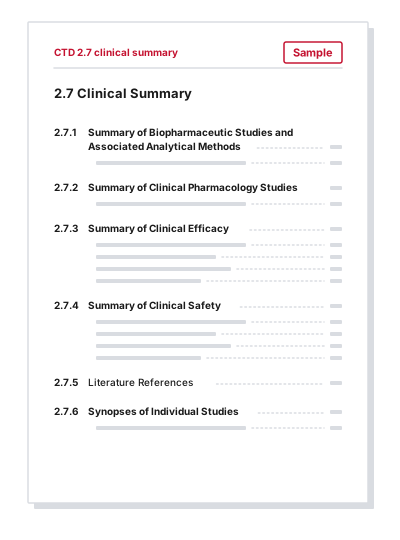
Figure caption
Shows the chapter organisation of CTD module 2.7.
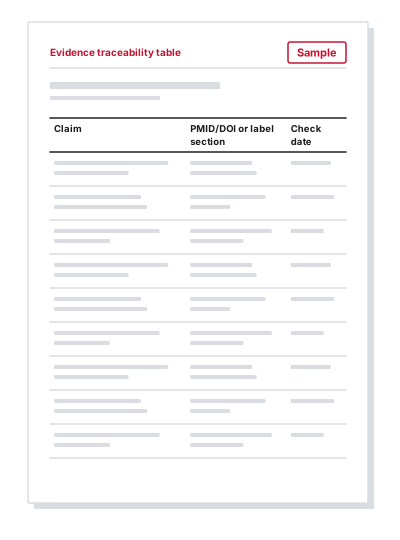
Figure caption
Shows records linking medical claims to their original sources.
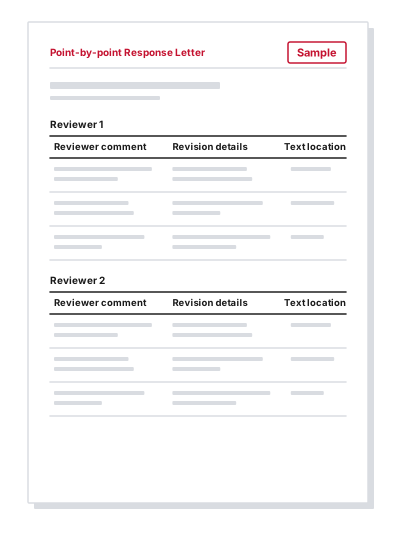
Figure caption
Shows the links between comments, their resolution and revision notes.
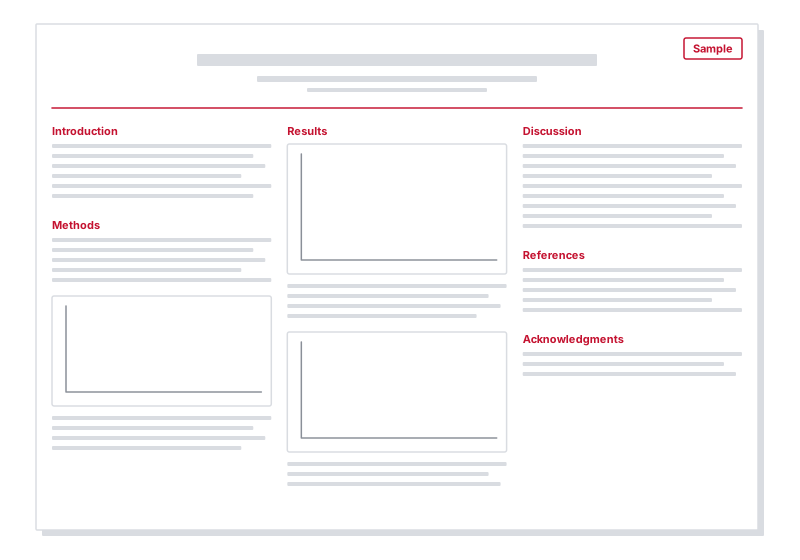
Figure caption
Shows the layout of study information, tables and figures.
04Medical Writing
Main statistical figures with multiple panels
These main figures show only how statistical results can be presented; all use Illustrative data.
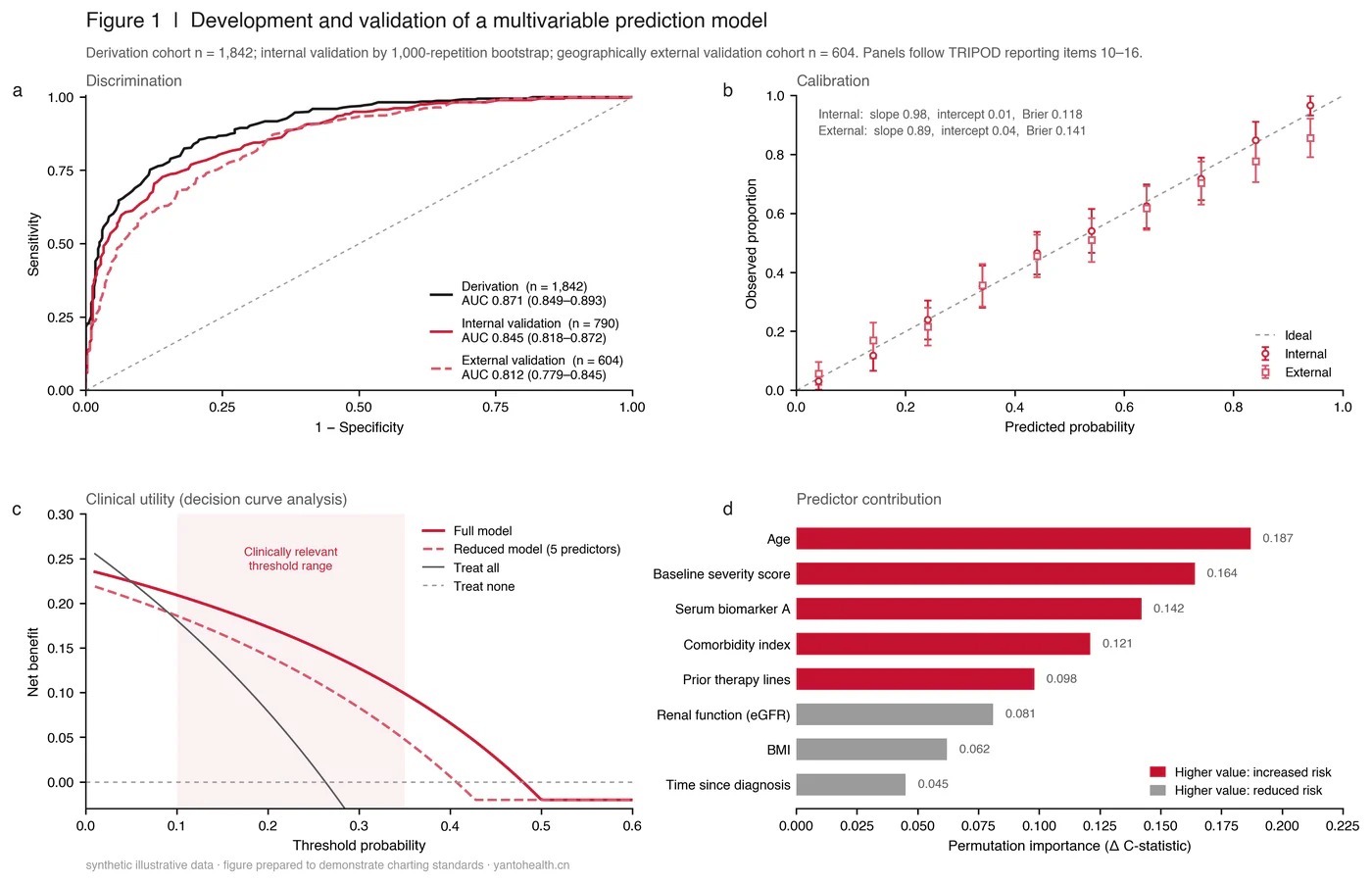
Figure caption
Four panels showing discrimination, calibration, clinical utility and variable contributions.
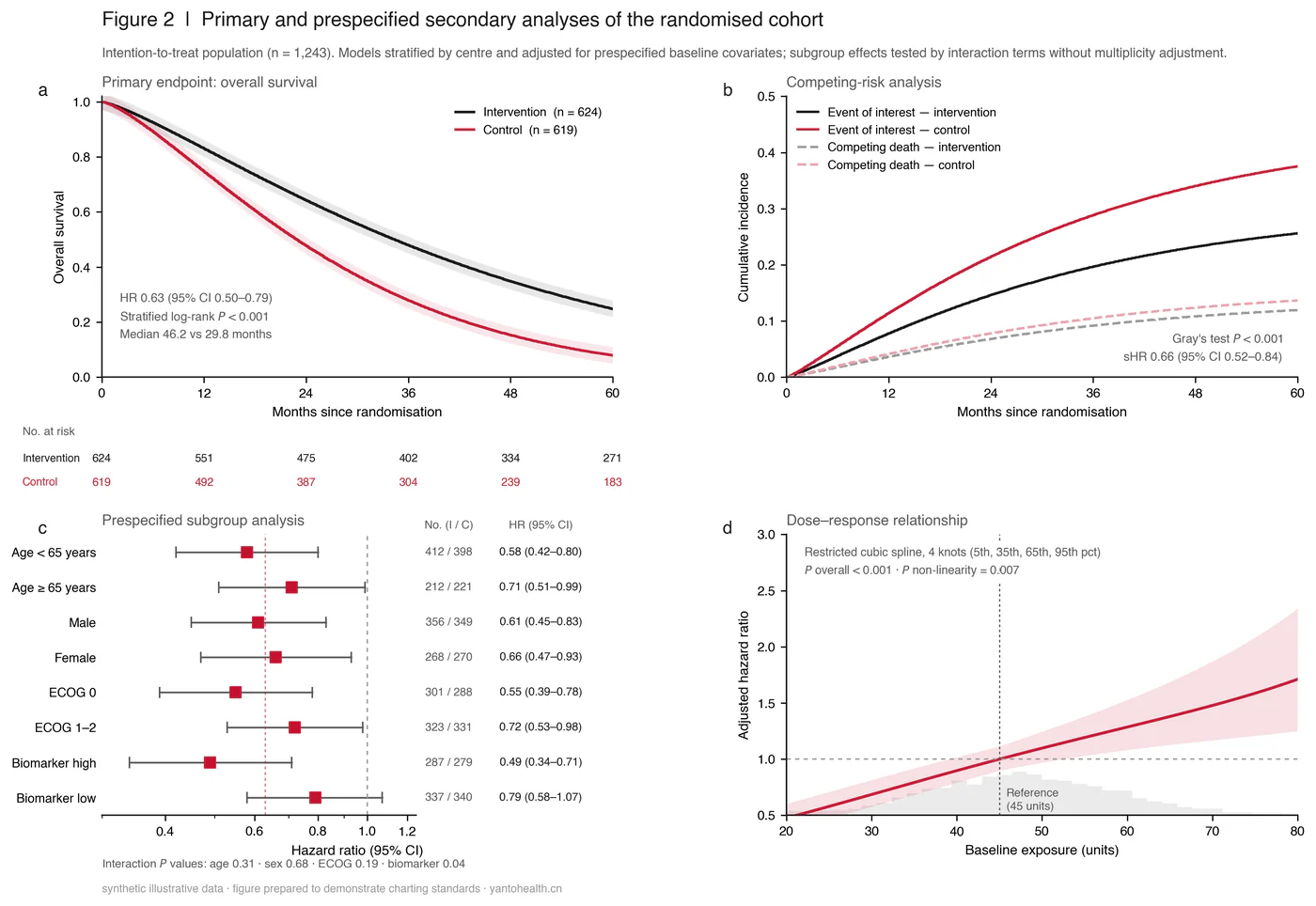
Figure caption
Main figure format for a randomised controlled trial.
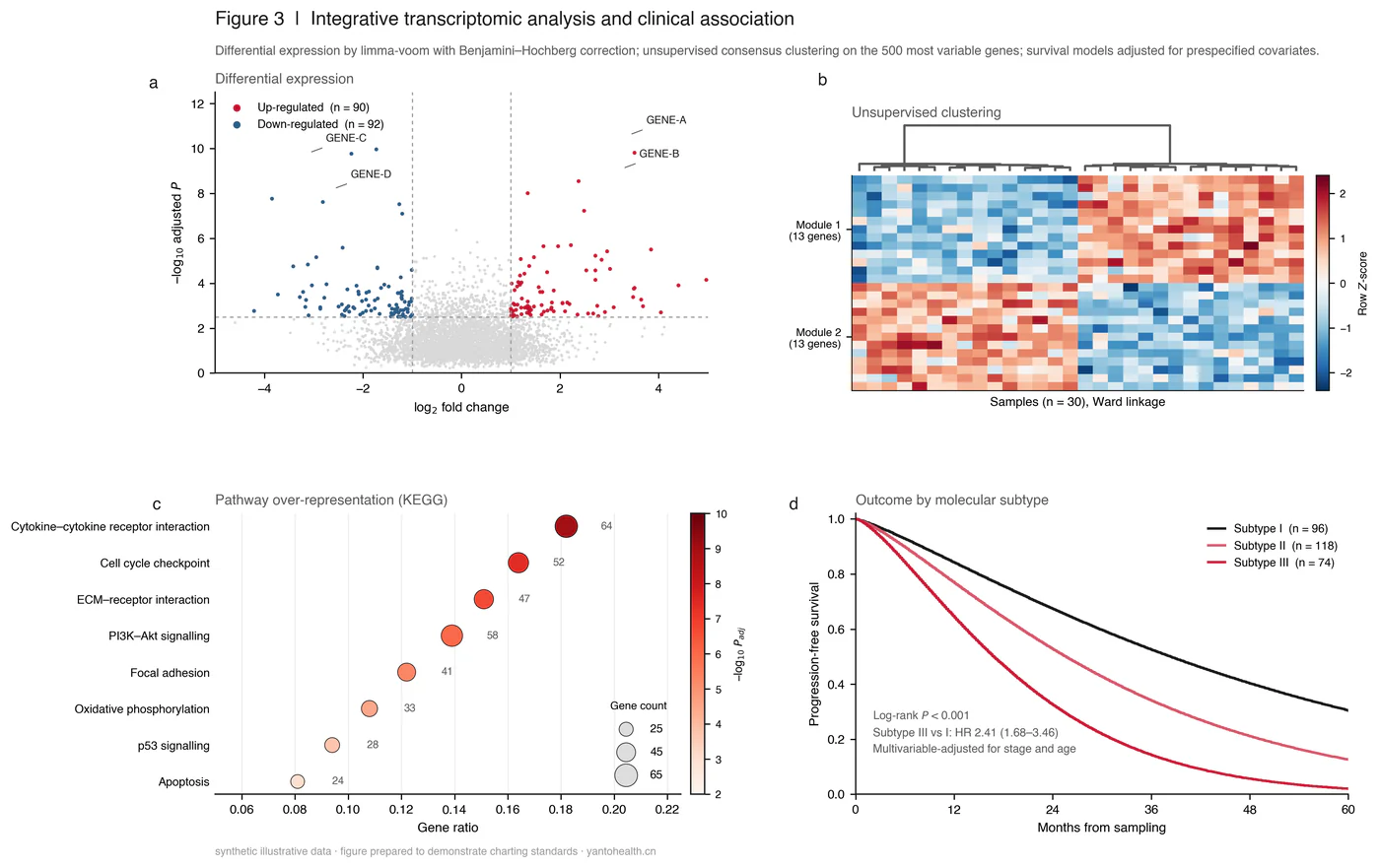
Figure caption
Main figure format for transcriptomic integration.
Panel labels, sample sizes, effect sizes and confidence intervals, statistical tests and multiple comparison adjustments follow the target journal's instructions for authors. Illustrative results are not used to claim project achievements or promise study conclusions.
05Medical Writing
Public research presentation examples
The following four scenarios show how evidence, figures and interpretation relate. All are examples of public research presentation: Not a Yanto Health project.
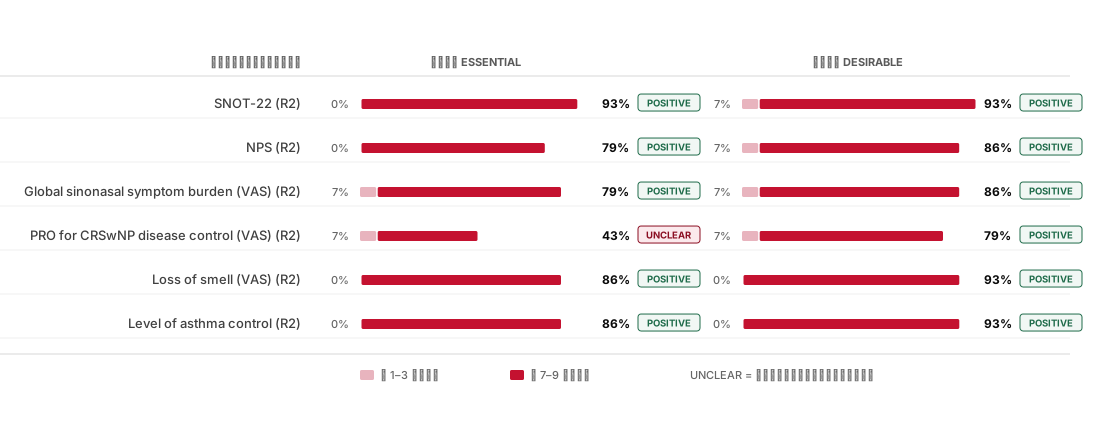
Figure caption
Figure redrawn from published literature. Rating proportions are presented separately for items that must be collected and those recommended for collection; this does not represent an expert consultation organised by us. Redrawn from Figure 10 in Backer et al. (Frontiers in Allergy, 2025, article 1680703); CC BY 4.0; Not a Yanto Health project.
Expert ratings must retain the distribution of views and the absence of consensus for each item. Items labelled UNCLEAR are not omitted because most items reached consensus. Our expert consensus service excludes expert selection and meeting organisation.
View expert consensus services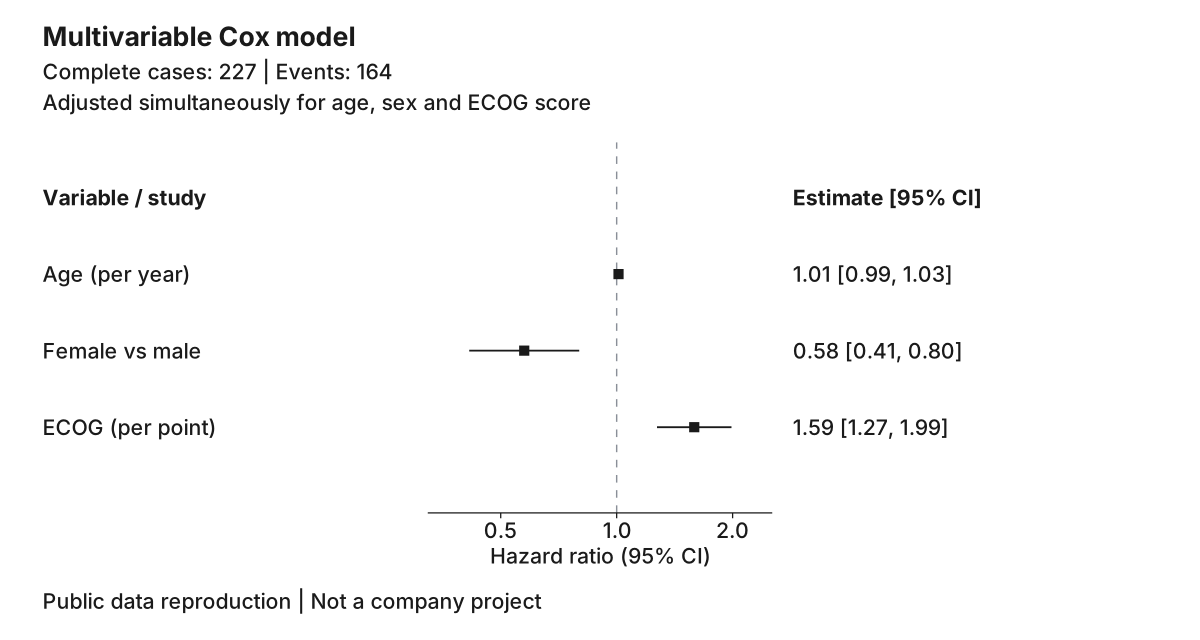
Figure caption
Reproduction of a public dataset. Data are from the lung dataset included in the R survival package. The analysis includes 227 complete cases and simultaneously adjusts for age, sex and Eastern Cooperative Oncology Group (ECOG) performance status. The figure shows hazard ratios (HR) and 95% confidence intervals (CI) from multivariable Cox regression. Findings are observational associations. Not a Yanto Health project.
Model results must retain adjustment variables, estimation precision and interpretive limits. Observational associations are not directly described as treatment effects.
View research publications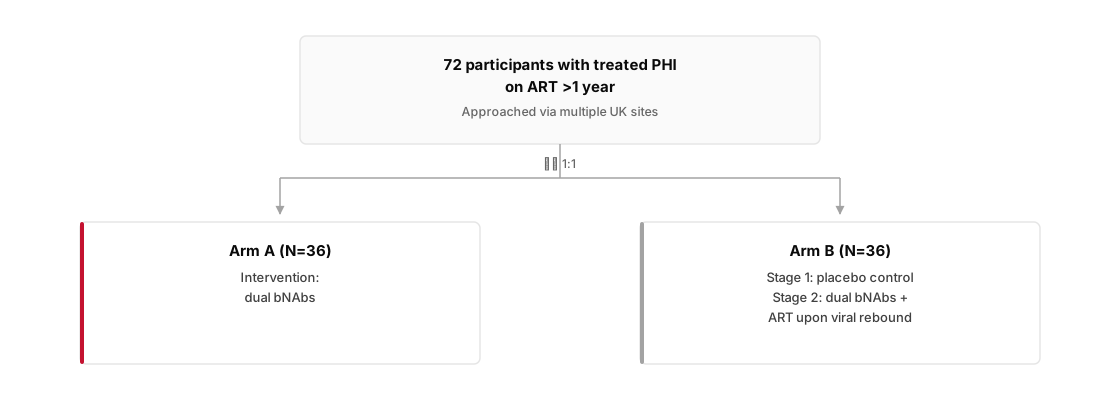
Figure caption
Redrawn study protocol diagram from a public source. Planned recruitment is 72 participants, allocated 1:1; the figure shows the planned sample size, not actual enrolment. Redrawn from the upper part of Figure 1 in Lee et al. (Trials, 2022, doi:10.1186/s13063-022-06151-w), with layout changes only; wording and groups are unchanged. CC BY 4.0; Not a Yanto Health project.
Target sample sizes and group allocation in a research plan should be described separately from actual enrolment. This public protocol diagram illustrates only how study information is organised.
View engagement boundaries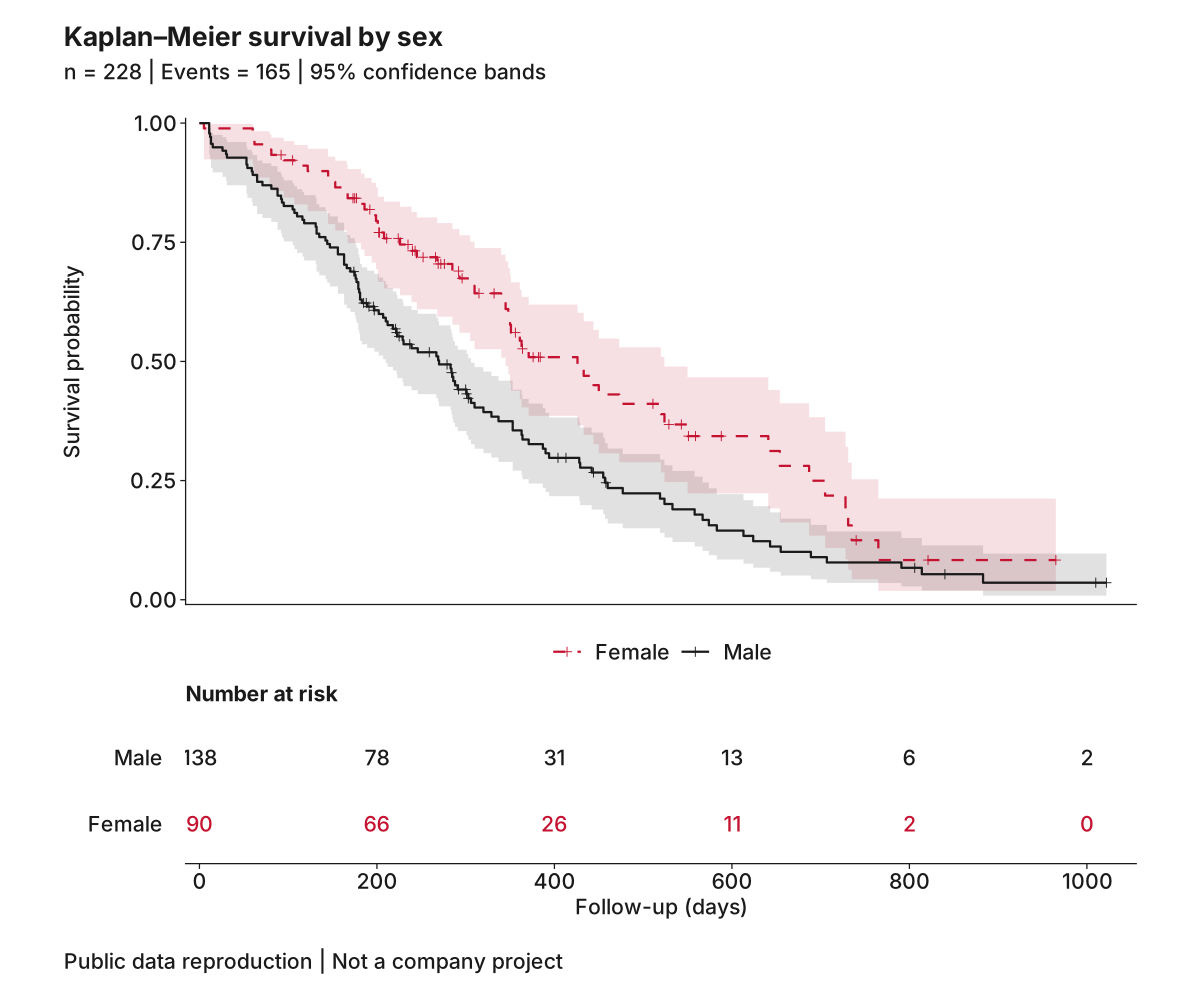
Figure caption
Reproduction of a public dataset. Data are from the lung dataset included in the survival package: 228 participants, comprising 138 men and 90 women, with 165 deaths. Shading shows 95% CI and ticks indicate censoring. Numbers at risk count participants still under follow-up and event-free immediately before each time point. Not a Yanto Health project.
Curves, confidence intervals, censoring marks and numbers at risk jointly describe the results. Interpretation of curve tails must consider how many participants remain under follow-up.
View evidence and statistics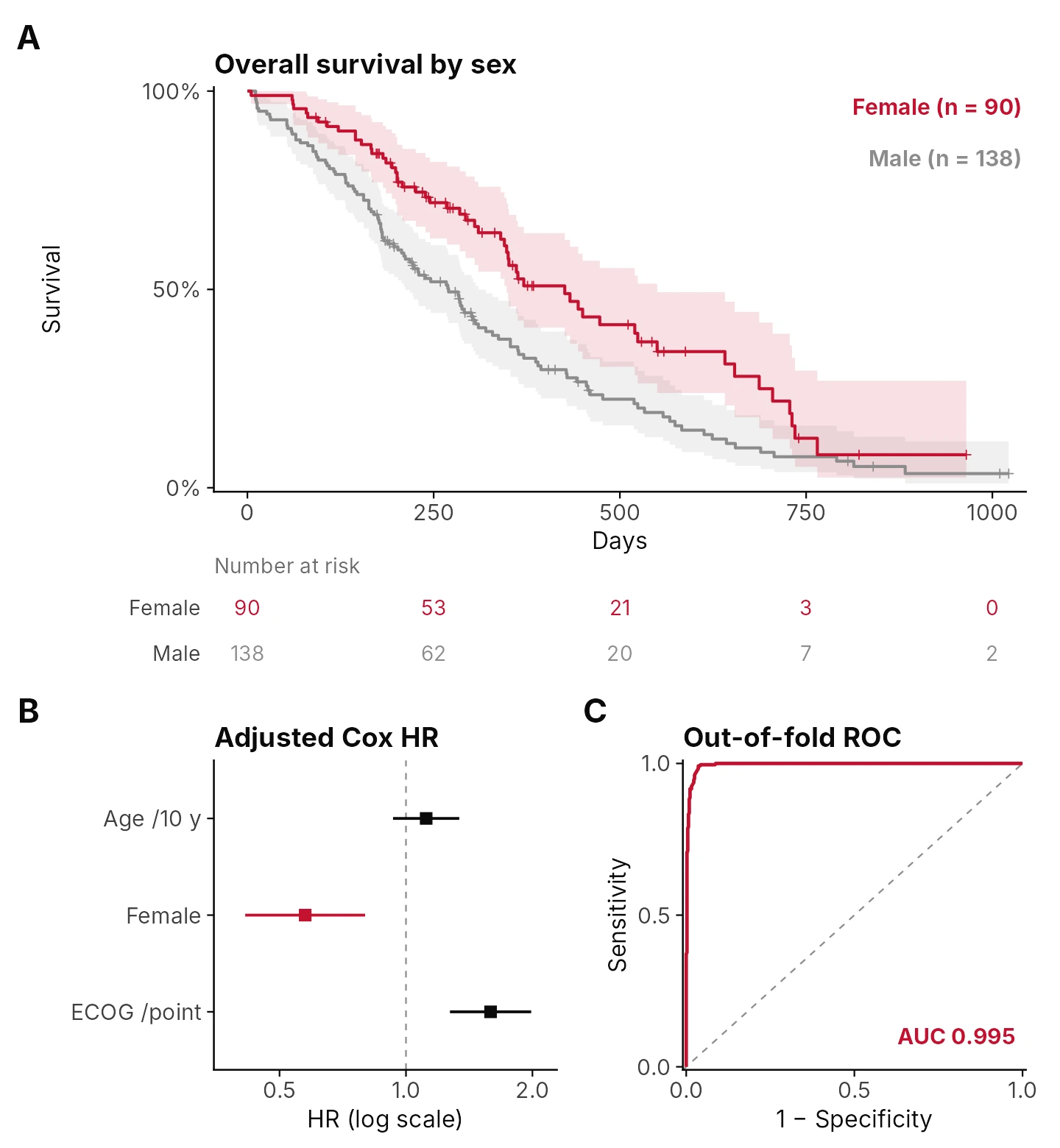
Figure caption
Figures reproduced by our company from the original public datasets. A and B show survival curves and numbers at risk by sex in the public survival::lung cohort, and an adjusted Cox model (227 complete cases); C shows an out-of-fold receiver operating characteristic (ROC) curve for the MASS::biopsy dataset (699 out-of-fold predictions). Results are observational associations. Not a Yanto Health project.
Groups, statistical results and processes from public research are used only as examples of scientific writing. This does not constitute drug advertising or recommendations on medicine use.
Get started · Submit a request
Submit a medical writing request
Clients can specify target documents, quantities, reference samples and the status of available materials in the request form. We first issue a requirement confirmation form, followed by an itemised quotation and schedule.
This section describes our services. It does not concern any specific medicinal product and does not constitute drug advertising. The timelines, quality control and issue resolution processes described are our standard operating approach; the final scope, timelines, prices and obligations of each party are governed by the signed contract.
Our contribution is disclosed in the acknowledgements in line with ICMJE and GPP 2022; we are not listed as authors. For writing and statistical support for research publications, involvement and funding sources are disclosed truthfully under the International Committee of Medical Journal Editors recommendations and Good Publication Practice 2022. We do not promise publication outcomes.