
Medical Writing

Clinical study report (CSR)

A clinical study report (CSR) brings together the design, conduct, efficacy and safety results of a single study for review by the sponsor's medical, statistics and regulatory teams and for the relevant regulatory review materials.

Service scope
We write CSRs and patient safety event narratives.

We undertake writing, structural organisation and consistency review; responsibility for sign-off and submission rests with the client.

01 · Deliverables

A complete report of study conduct, analysis results and clinical interpretation

Deliverables

Clinical study report (CSR)

Service scope
We write CSRs and patient safety event narratives.
Deliverables

Draft CSR and patient safety event narratives.

Specifications and timeline
Written to the chapter 1–16 structure of ICH E3. Safety event narratives follow section 12.3.2 of ICH E3. Timelines are confirmed for each project.
Pricing basis
We confirm the scope of the engagement before quotation.

We can start with a single document or chapter, reviewed and signed off by the client's regulatory or medical department. Specific deliverables are defined in the requirement confirmation form and contract.

Writing timelines depend on data readiness, document length and review rounds. We provide a project-specific schedule in the requirement confirmation form.
02 · Content structure

ICH E3 chapter structure

Chapters must be linked, and the synopsis and conclusions must be traceable to results and supporting materials.

Figure 1 CSR chapters and supporting evidence · Illustrative structureReport details and backgroundChapters 1–8Study conduct and resultsChapters 9–13Supporting documentsChapters 14–16Chapters 11, 12 ↔ Chapters 14, 16Figure 1 CSR chapters and supporting evidence · Illustrative structureReport details and backgroundChapters 1–8Study conduct and resultsChapters 9–13Supporting documentsChapters 14–16Chapters 11, 12 ↔ Chapters 14, 16
Figure 1CSR chapters and supporting evidenceIllustrative structure
Figure caption

Illustrative structure based on chapters 1–16 of ICH E3; no study data or regulatory review conclusions are included.

Report details and background
1 Title page; 2 Synopsis; 3 Table of contents; 4 List of abbreviations and definition of terms; 5 Ethics; 6 Investigators and study administrative structure; 7 Introduction; 8 Study objectives.
Study conduct and results
9 Investigational plan; 10 Study patients; 11 Efficacy evaluation; 12 Safety evaluation; 13 Discussion and overall conclusions.
Supporting documents
14 Tables and figures referred to but not included in the text; 15 Reference list; 16 Appendices.

03 · Work steps

Consistency checks between analysis outputs and text

Tables, listings and figures (TLF) provide an important basis for writing results. Checks must cover versions, numerical values and interpretation.

  1. Input materials and versions

    Confirm versions of the protocol and amendments, statistical analysis plan, analysis outputs and safety event materials; distinguish planned activities from actual conduct.

  2. Link chapters to outputs

    Link results paragraphs to TLF numbers and check analysis sets, outcome definitions, time windows and denominators.

  3. Numerical and reporting consistency checks

    Check population sizes, percentages, units, effect sizes and confidence intervals individually; use consistent definitions across the text, tables/figures and synopsis.

  4. Check safety narratives

    Check event chronology, management and outcomes. Record missing or inconsistent information as unresolved issues, without adding causal judgements unsupported by the materials.

  5. Complete revisions and version checks

    After changes to materials or outputs, recheck affected text, synopsis, conclusions and references, recording review comments and their resolution.

This is the general sequence for consistency checks. Specific work such as statistical analysis and data processing is defined in the requirement confirmation form; CSR writing does not automatically extend that scope.

04 · Standards and guidance

Guidance on report structure and safety narratives

The International Council for Harmonisation of Technical Requirements for Pharmaceuticals for Human Use (ICH) E3 guideline, Structure and Content of Clinical Study Reports (Step 4 version, 30 November 1995), defines the core structure and content of a CSR.

Guidance on report structure and safety narratives
Standard and scopeVersion, content and purpose
Overall structureChapters 1–16 of ICH E3 cover the report body, figures/tables, references and appendices.
Design and analysisICH E3 section 9.7 covers planned statistical methods and sample size, and section 9.8 covers changes in study conduct or planned analyses; section 11.1 covers datasets analysed, and section 11.4 covers efficacy results and statistical interpretation.
Safety resultsICH E3 chapter 12 covers safety evaluation; section 12.3.2 covers narratives of deaths, other serious adverse events and certain other significant adverse events.
Supporting materialsICH E3 chapter 14 covers tables and figures referred to but not included in the text, and chapter 16 covers appendices.

ICH E3 guideline.

05 · Samples and examples

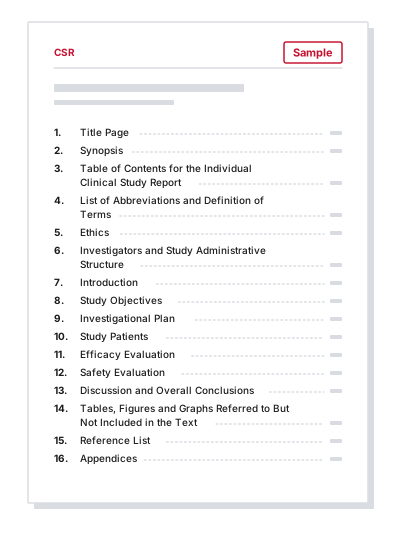
Contents page sample

The sample shows the chapter hierarchy and does not represent a completed regulatory submission project.

Figure 2 CSR contents page sample · Illustrative sample
Figure 2CSR contents page sampleIllustrative sample
Figure caption

Arranged according to the published headings for chapters 1–16 of ICH E3, with page numbers represented by grey lines. No actual study results are included.

06 · Frequently asked questions

Frequently asked questions

Scope of statistical analysis and report writing

When statistical results are available, we can begin with writing. If statistical analysis or review is needed, the scope and deliverables are defined separately in the requirement confirmation form.

Sign-off, publishing and submission

We undertake writing, structural organisation and consistency review; responsibility for sign-off and submission rests with the client. We do not undertake electronic common technical document (eCTD) publishing or submission, formal communication with regulatory review agencies, or on-site defence of submissions.

Regulatory submission track record

This is an area we are developing. For NMPA regulatory submission projects: We do not yet have a prior track record that we can cite publicly. If a project requires evidence of comparable submissions from suppliers, the client should state this when requesting a quotation.

Safety event narratives and individual case safety reports

We can write patient safety event narratives for clinical studies; we do not collect, assess or submit individual case safety reports, or act as the party responsible for pharmacovigilance.

Get started · Submit a request

Submit a medical writing request

Please provide the study stage, chapters or full document to be commissioned, the status of the protocol and analysis outputs, intended use and timing requirements.

Submit a medical writing requestFor regulatory submission requests, we confirm engagement boundaries before providing a quotation. Reply within 24 hours (business days first). · contact@yantohealth.cn