Medical Writing

Evidence and statistics

From search questions to interpretation of results, we retain the links between evidence screening, analytical methods and result sources.

Relevant departments
R&D, Medical Affairs, clinical research, statistics and other departments needing specialist evidence support.

This service covers literature searches, Field evidence reviews, target evidence and competitive landscape reviews, preclinical experimental statistics, and meta-analysis, survival analysis and prediction models. Statistical deliverables include analysis code, results tables and figures, and methods descriptions that allow verification. The service supports all development stages and the three service areas, and can also be commissioned separately.

01Medical Writing

Service scope and deliverables

Each service below specifies its scope, deliverables, specifications and timeline, and pricing basis.

Literature searches

Service scope
Systematic literature searching and bibliographic organisation.
Deliverables
Search strategy, database-specific search logs, eligible reference list and Excel bibliographic table.
Specifications and timeline
No more than 5 working days in total.
Pricing basis
Priced per item.

Field evidence reviews

Service scope
We bring together evidence in a specific field, describing the degree of support and conflict between studies.
Deliverables
Evidence summaries stratified by population, region and research methods, with updates as new evidence emerges.
Specifications and timeline
Systematic reviews follow the Preferred Reporting Items for Systematic Reviews and Meta-Analyses (PRISMA) 2020 checklist. Timeline confirmed for each project.
Pricing basis
Priced per item; ongoing updates can be arranged as ongoing content support.

Meta-analysis, survival analysis and prediction models

Service scope
Meta-analysis, survival analysis and prediction models.
Deliverables
Analysis code, results tables and figures, and methods descriptions that allow verification; multi-panel main figures and reporting standards checklist; includes systematic reviews and meta-analyses of preclinical animal studies.
Specifications and timeline
Receiver operating characteristic (ROC) curves and area under the curve (AUC) are reported with confidence intervals. Calibration is reported using the calibration intercept and slope, with the Brier score reported separately as an overall performance measure. Internal validation uses 1,000 bootstrap resamples. Reporting is checked item by item against the applicable study-specific standards, with a checklist supplied. Systematic reviews of animal studies use the SYRCLE risk of bias tool. Timeline confirmed for each project.
Pricing basis
Priced per item; where the client writes the manuscript, statistical review alone can be commissioned.

Target evidence reviews and competitive landscape reports

Service scope
Structured reviews of evidence on targets and disease mechanisms, development pipelines for the same target, and existing clinical evidence.
Deliverables
Structured evidence review; pipeline table for the same target, with public sources and search dates.
Specifications and timeline
Pipeline information uses public sources only, with search dates stated. It does not constitute definitive advice for investment or R&D decisions. Timeline confirmed for each project.
Pricing basis
Priced per item.

Statistical analysis and statistical review of preclinical experiments

Service scope
Statistical analysis and statistical review of preclinical pharmacodynamic, pharmacokinetic and mechanistic studies.
Deliverables
Review comments on experimental design and sample size; analysis code and results tables and figures.
Specifications and timeline
Covers between-group comparisons, repeated measures and adjustment for multiple comparisons; experimental design, sample size and blinding are reported according to ARRIVE 2.0. Timeline confirmed for each project.
Pricing basis
Priced per item; where the client writes the manuscript, statistical review alone can be commissioned.

02Medical Writing

Typical workflow

Searches, evidence synthesis and statistical modelling have different input requirements. Define the research question before selecting the workflow.

01Literature searches

  1. Define the question and eligibility scope
  2. Select databases and search platforms
  3. Develop and check search strings
  4. Run searches and record dates
  5. Deduplicate and organise bibliographic records
  6. Prepare search logs and reference lists.

02Field evidence reviews

  1. Define populations, outcomes and study scope
  2. Screen references and record exclusion reasons
  3. Extract study characteristics and results
  4. Appraise study limitations
  5. Organise evidence summaries by population, region and methods
  6. Describe evidence consistency and gaps.

03Meta-analysis

  1. Define questions and effect measures suitable for synthesis
  2. Check studies and data extraction
  3. Select models and heterogeneity analysis methods
  4. Conduct applicable sensitivity analyses
  5. Prepare results tables and figures, and interpretation.

04Survival analysis

  1. Define time origin, events and censoring rules
  2. Check data and follow-up
  3. Specify models and adjustment variables
  4. Check model assumptions
  5. Report numbers at risk, effect estimates and uncertainty.

05Prediction models

  1. Define prediction time points and outcomes
  2. Specify the development and validation design
  3. Handle missing data and data splitting
  4. Fit and validate models
  5. Report discrimination, calibration and limitations separately.

06Target evidence reviews and competitive landscape reports

  1. Define target and disease scope
  2. Search public evidence and development pipelines for the same target
  3. Record public sources and search dates
  4. Check evidence and pipeline information
  5. Prepare a structured review and pipeline table

07Statistical analysis and statistical review of preclinical experiments

  1. Confirm client-supplied data and experimental design materials
  2. Review experimental design and sample size information
  3. Conduct statistical analysis and applicable adjustment for multiple comparisons
  4. Check reporting against ARRIVE 2.0
  5. Deliver analysis code, results tables and figures, and review comments

Reporting checklists describe the methods and results completed. They do not ensure that a study is free from bias or replace a study protocol. Interpretation of results should reflect the strength of the evidence.

Package engagement

Standalone tasks and support within projects

Evidence and statistics can be commissioned separately or included in medical education, research publication or clinical documentation projects. Clients may commission only evidence searches, statistical analysis or statistical review, with the remaining work performed by the client or a third party.

Input materials, analysis scope, deliverables and acceptance criteria are specified for each project; no fixed packages or additional starting prices are assumed.

03Medical Writing

Applicable standards

Search records should show where, when and how searches were performed. Statistical reports should describe the analysis population, methods and uncertainty.

Field evidence reviews are named according to their methods; materials without systematic searching and screening are not called systematic reviews merely because they include a reference list. Statistical figures should state data sources and validation methods; internal validation does not replace external validation.

Applicable standards
Standard, version and locationItems to check
PRISMA 2020, items 5–8, 13, 16 and 20.Eligibility criteria, information sources, complete search strings, selection processes, synthesis methods, and selection and synthesis results.
PRISMA extension for reporting literature searches in systematic reviews (PRISMA-S, 2021), items 1, 8 and 12–16.Databases and platforms, complete search strategies, update methods, search dates, search peer review, record counts and deduplication methods; state truthfully if search peer review was not performed.
Strengthening the Reporting of Observational Studies in Epidemiology (STROBE, 2007), items 7, 12, 16 and 19.Variable definitions, statistical methods, main results and limitations.
TRIPOD+AI reporting guideline for multivariable prediction models (2024), items 12a, 12c, 12e and 23a in the 27-item checklist.Data splitting, model development and internal validation, performance evaluation methods, and performance results with confidence intervals; applicable to regression and machine learning methods.
ARRIVE 2.0;Percie du Sert N, et al. The ARRIVE guidelines 2.0: Updated guidelines for reporting animal research. PLoS Biol 2020;18(7):e3000410. PMID 32663219Experimental design, sample size and blinding.
SYRCLE risk of bias tool; Hooijmans CR, et al. SYRCLE's risk of bias tool for animal studies. BMC Med Res Methodol 2014;14:43. PMID 24667063Risk of bias assessment in systematic reviews of animal studies.

04Medical Writing

Statistical presentation examples

The following reproductions of public data demonstrate statistical presentation formats. All are labelled: Not a Yanto Health project.

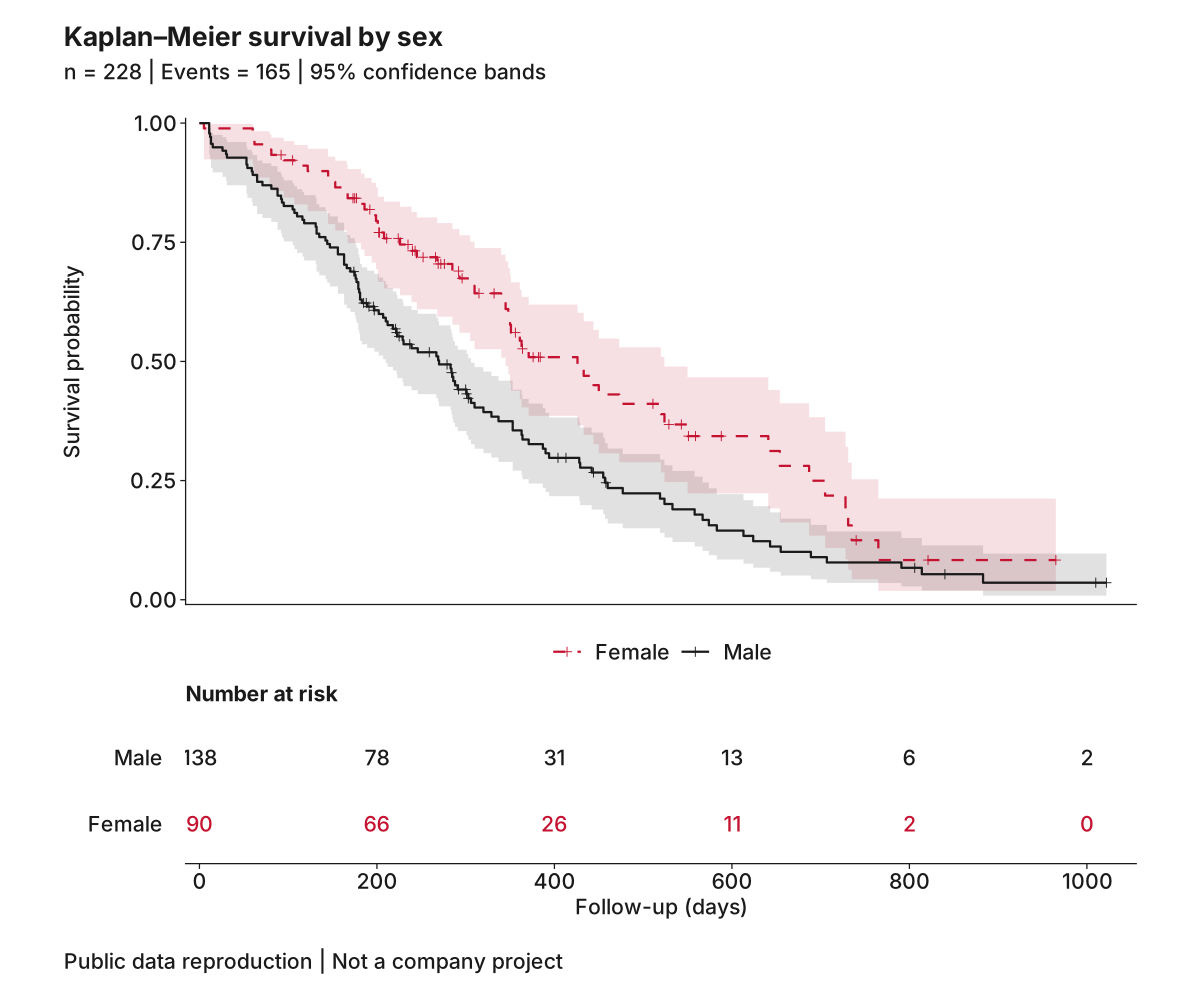
Kaplan–Meier survival curves and numbers-at-risk table; Reproduction of public data · Not a Yanto Health project
Figure 1Kaplan–Meier survival curves and numbers-at-risk tableReproduction of public data · Not a Yanto Health project
Figure caption

Reproduced using the public survival::lung dataset. There are 228 participants: 138 men and 90 women, with 165 deaths. Shading indicates 95% confidence intervals and tick marks indicate censoring. Numbers at risk count participants still under follow-up and event-free immediately before each time point.

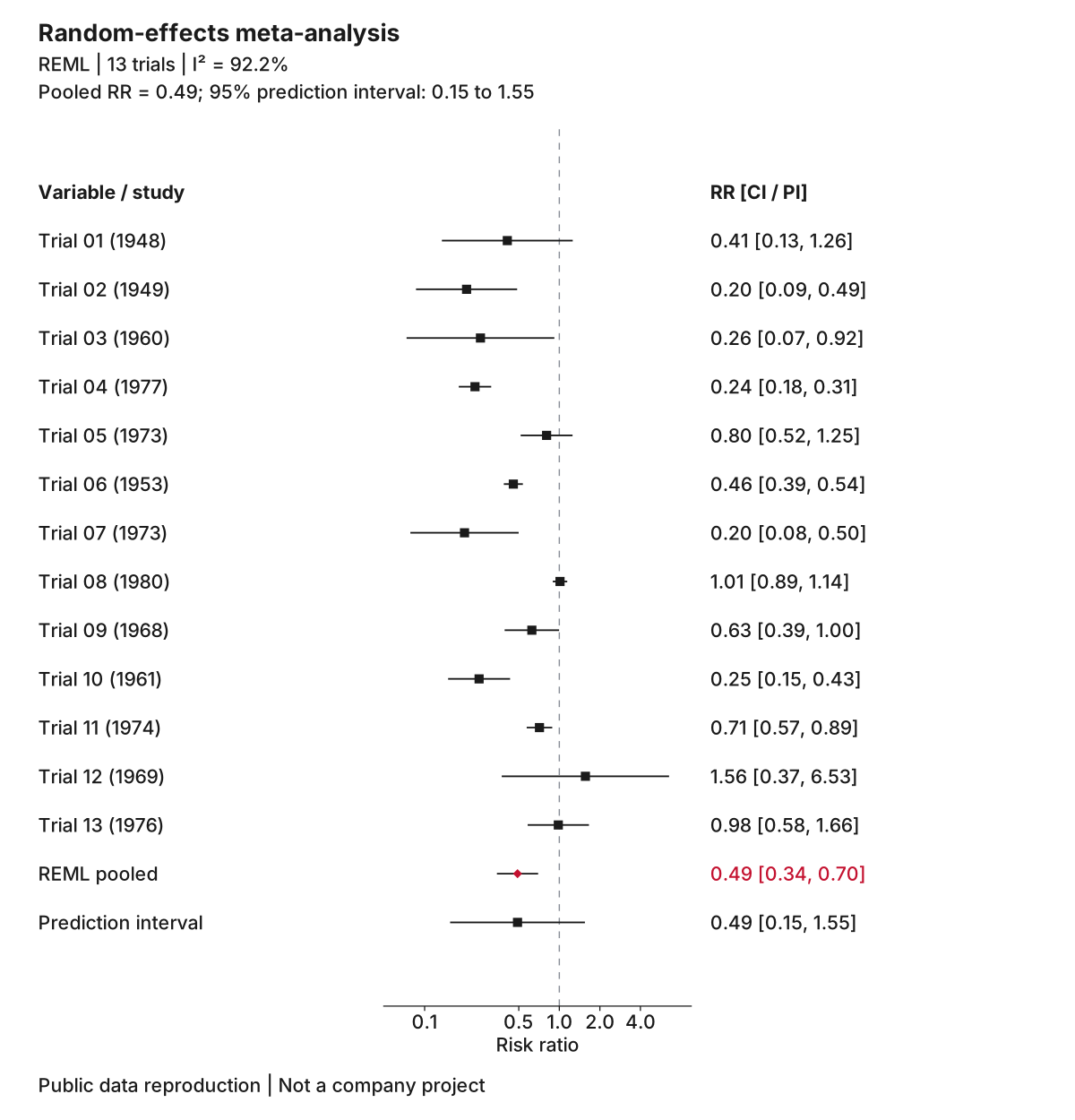
Random-effects meta-analysis forest plot; Reproduction of public data · Not a Yanto Health project
Figure 2Random-effects meta-analysis forest plotReproduction of public data · Not a Yanto Health project
Figure caption

Reproduced from the public aggregate trial dataset dat.bcg, including 13 trials. The restricted maximum likelihood (REML) random-effects pooled risk ratio (RR) is 0.49, with a 95% confidence interval of 0.34–0.70 and heterogeneity I² of 92.2%; the 95% prediction interval is 0.15–1.55. Intervals use a normal approximation. The prediction interval retains heterogeneity in the true effect of a new study; the pooled estimate does not replace interpretation of differences between studies.

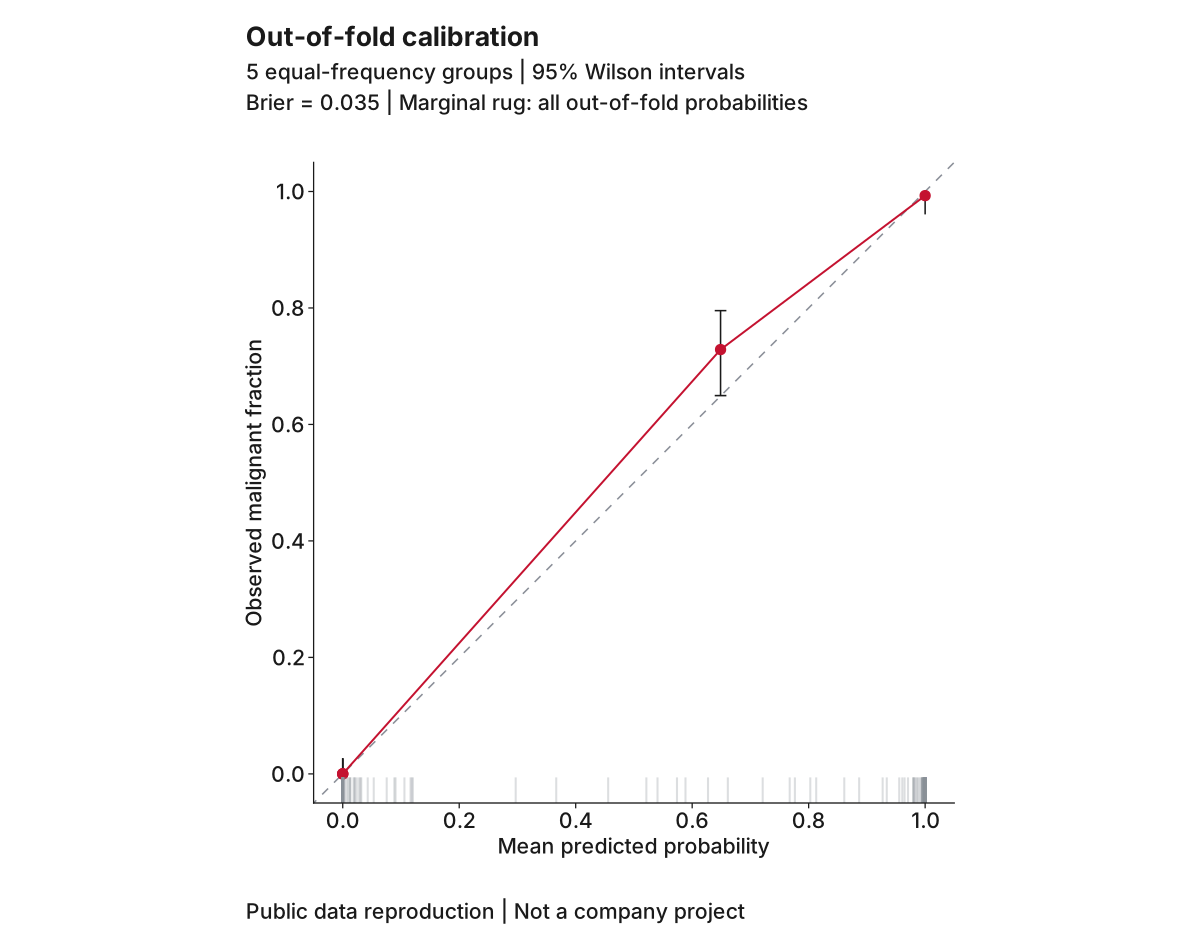
Out-of-fold prediction calibration plot; Reproduction of public data · Not a Yanto Health project
Figure 3Out-of-fold prediction calibration plotReproduction of public data · Not a Yanto Health project
Figure caption

Reproduced using the public MASS::biopsy dataset, with 699 out-of-fold predictions divided into 5 groups by predicted probability rank; ties are split in original record order. Observed rates within groups have 95% Wilson confidence intervals. The Brier score is 0.035; connecting lines aid reading only, and out-of-fold predictions have not been recalibrated. This example shows internal validation, not external validation or clinical effectiveness.

05Medical Writing

Frequently asked questions

Scope of literature searches and systematic reviews

Literature searches deliver a search strategy, database-specific search logs, eligible reference list and bibliographic table. Systematic reviews additionally involve predefined eligibility criteria, screening, data extraction, evidence appraisal and synthesis. The requirement confirmation form should specify whether these subsequent steps are included.

Literature search timelines

The current literature search service specifies no more than 5 working days in total. This must not be extended to a general timeline for a complete systematic review or meta-analysis; those timelines are confirmed for each project.

Verification of analysis results

Statistical analysis delivers code, results tables and figures, and methods descriptions that allow verification. The client or a third party can check results with the same data, code and execution environment. Model selection and interpretation within a project should have an explicit rationale.

Engagement when only statistical results are available

With existing statistical results, work can begin with result review or manuscript preparation. Where the client writes the manuscript, statistical review alone can be commissioned. If existing materials are insufficient for verification, the additional materials needed and the scope must first be defined.

Example results and project capabilities

The statistical figures on this page reproduce public data; they are not client projects or evidence of treatment effects. Different figures may use different datasets. Sample sizes, models and validation methods in the examples cannot be transferred directly to commissioned projects.

Get started · Submit a request

Submit a medical writing request

Please provide the research question, status of data or literature, proposed analyses, target deliverables and deadlines. We first issue a requirement confirmation form, followed by an itemised quotation and schedule.

Submit a medical writing requestReply within 24 hours (business days first) · contact@yantohealth.cn