
Cost-effectiveness and cost-utility analysis
Compare differences in costs and health outcomes between options. When quality-adjusted life years (QALY) are used, the sources of utility values and estimation methods must be described.
Medical Writing
Health economic evaluation compares the costs and health outcomes of different options for medical, health economics and market access teams and relevant professional reviewers. Conclusions must be read alongside the evaluation perspective, comparators, time horizon and model assumptions.
Cost-effectiveness does not imply budget savings; the two analyses answer different questions.
01 · Deliverables
The commissioned scope is confirmed against the research question and intended use. The current deliverables are listed below.
Compare differences in costs and health outcomes between options. When quality-adjusted life years (QALY) are used, the sources of utility values and estimation methods must be described.
Estimate budget changes over a defined period after an option is introduced, from the budget holder's perspective, considering the eligible population size, uptake and resource expenditure.
Health economics documents and models
A health economic evaluation protocol, specifying the evaluation perspective, comparators, cost scope, time horizon and discounting assumptions.
A cost-effectiveness/cost-utility analysis report.
A budget impact analysis report.
A systematic literature review of parameters required for economic evaluation, including costs and utility values.
A health economic evaluation manuscript for journal submission, with a CHEERS 2022 checklist.
An executable health economic model in Excel or R, according to the client's requirements.
Draft economic sections for a value dossier.
Model files use Excel or R, as confirmed according to the client's requirements.
02 · Content structure
Illustrative model structure, without real or simulated effect estimates.
Model structure must reflect the research question, available data and evaluation purpose; every structure has conditions for use and limitations.
Branches represent event pathways, suiting questions with a relatively clear event sequence and limited need for repeated state transitions. For long-term recurrent events, assess whether this structure adequately represents the process.
Health states, cycles and transitions describe the course of disease. State definitions, transition estimates and assumptions about prior disease history must be described.
Survival functions estimate the proportions in each health state. Curve sources, extrapolation methods and mutual consistency must be explained; model choice cannot rely solely on goodness of fit.
03 · Work steps
Define the evaluation perspective, comparators, cost scope, time horizon and discounting, distinguishing the tasks of cost-effectiveness and budget impact analysis.
Record the sources, units, times and populations for effect, cost, utility and other parameters; explain choices when sources disagree.
Select a structure appropriate to the question and materials, link parameters and assumptions to calculated results, and check units, state proportions and key calculation relationships.
Examine how changes in key parameters and scenarios affect results, avoiding reporting only favourable scenarios.
Check model outputs, text, figures/tables and conclusions, describe limitations and requirements for running the model, and retain comment resolution records.
04 · Standards and guidance
Methodological guidelines, reporting checklists and budget impact analysis recommendations serve different purposes.
| Standard and scope | Version, content and purpose |
|---|---|
| Economic evaluation reporting | The Consolidated Health Economic Evaluation Reporting Standards (CHEERS 2022) contain 28 items. Item 4 concerns the analysis plan; items 8–10 concern perspective, time horizon and discounting; items 14–17 concern costs, price year, models and assumptions; item 20 concerns uncertainty; items 22–25 concern main results and related effects.CHEERS 2022 statement. |
| Parameter evidence reviews | The Preferred Reporting Items for Systematic Reviews and Meta-Analyses (PRISMA) 2020 main checklist is used for reporting systematic literature reviews. Items 6–9 address information sources, searches, selection and data collection; item 16 addresses study selection results.PRISMA 2020 statement. |
CHEERS 2022 supports complete and transparent reporting. It is not a model certification standard and does not replace review of model structure, parameters and applicability.
05 · Samples and examples
The example shows the joint distribution of incremental costs and health outcomes and how conclusions depend on willingness-to-pay assumptions.
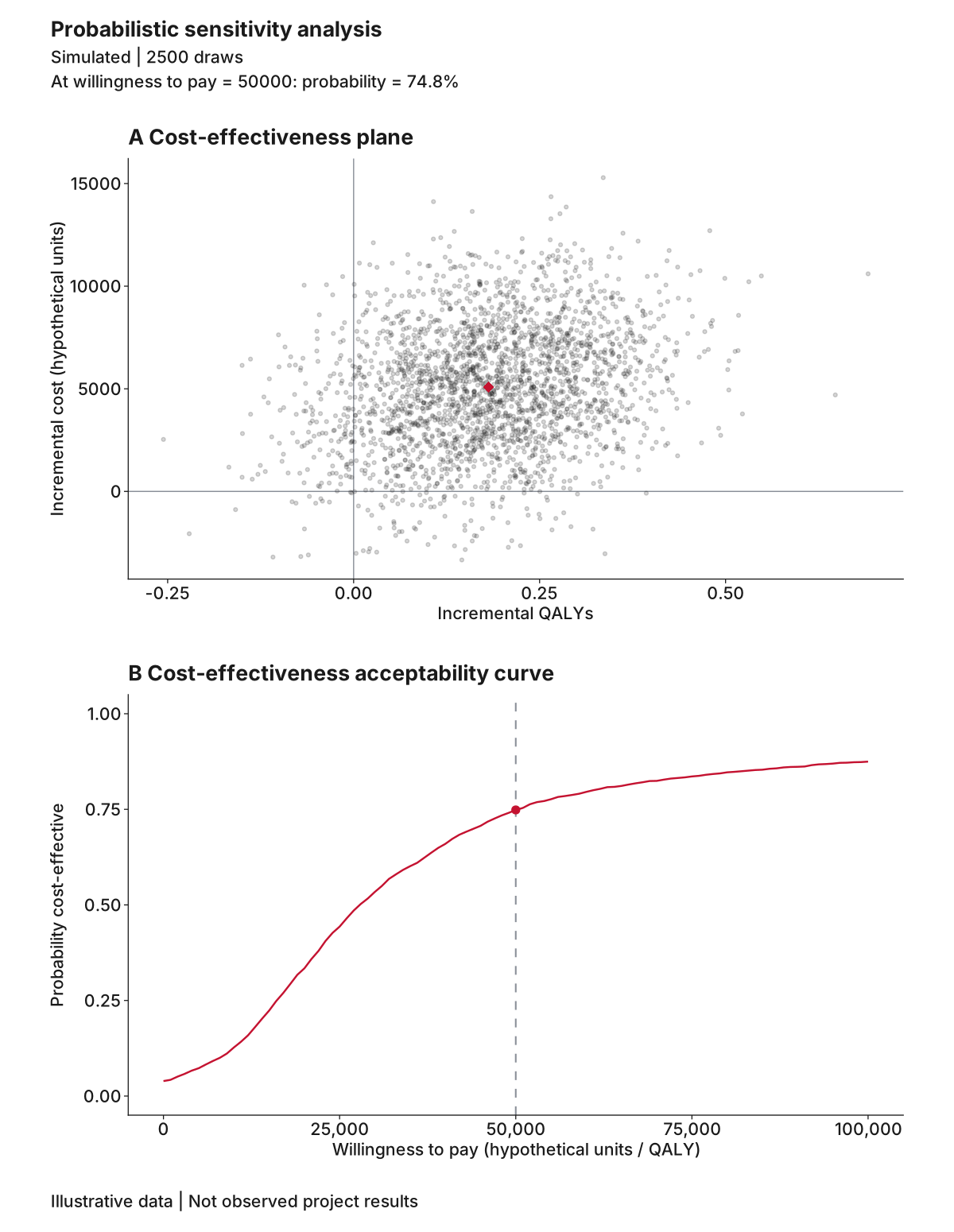
The data are simulated, using 2,500 correlated samples of incremental costs and incremental QALYs. Mean incremental QALYs are 0.181 and mean incremental costs are 5,079 hypothetical currency units. At a willingness to pay of 50,000 units/QALY, the proportion with positive net monetary benefit is 74.8%. Results do not correspond to any real technology, regional prices or reimbursement decision.
06 · Frequently asked questions
The current deliverables include executable health economic model files in Excel or R, as confirmed according to the client's requirements. The specific modelling scope is listed in the requirement confirmation form.
Cost-effectiveness analysis examines relative changes in costs and health outcomes; budget impact analysis examines changes in total expenditure in a specific budget setting. Neither can replace the other.
Parameter gaps, extrapolation assumptions and uncertainty must be described in the report; scenario assumptions must not be presented as observed study results.
Writing and statistical support for journal submission follows the recommendations of the International Committee of Medical Journal Editors (ICMJE) and Good Publication Practice 2022. Our contribution is disclosed in the acknowledgements in line with ICMJE and GPP 2022; we are not listed as authors. We do not promise publication outcomes.
Get started · Submit a request
Please provide the evaluation question, target region and intended use, comparators, available data or models, proposed deliverables and timing requirements.
This section describes our services. It does not concern any specific medicinal product and does not constitute drug advertising. Final deliverables, timelines, prices and each party's obligations are governed by the contract signed by both parties.
Writing and statistical support for research publications follows the recommendations of the International Committee of Medical Journal Editors (ICMJE) and Good Publication Practice 2022. Our contribution is disclosed in the acknowledgements in line with ICMJE and GPP 2022; we are not listed as authors. Funding sources are also disclosed truthfully. We do not promise publication outcomes.