
Medical information Q&A
We provide Medical information Q&A. See the Medical affairs and medical education page for service content and deliverables.
Medical Writing
Spine surgery, neurosurgery, orthopaedics, nephrology and cardiovascular medicine are the fields in which team members currently hold editorial roles. This page lists relevant services according to the research and document characteristics of each field.
The research characteristics below describe publicly available knowledge and do not represent our project record. For commissioned products outside these fields, we do not use having an editor in that field as a reason to accept the work.
01Medical Writing
Pain, function and imaging outcomes need separate definitions and interpretation within the same follow-up framework.
Measurement tools in spine research must match the anatomical site and research purpose. Lumbar studies may assess pain and daily function, while cervical studies require corresponding functional measures. Documents must specify scale names, versions, scoring direction and assessment time points. Imaging changes and improvements in patient function should be reported separately and cannot be treated as the same outcome.
Study documents must describe surgical approaches, eligible populations, follow-up arrangements and safety observations. For publication, reporting guidelines are selected according to whether the design is randomised or observational.
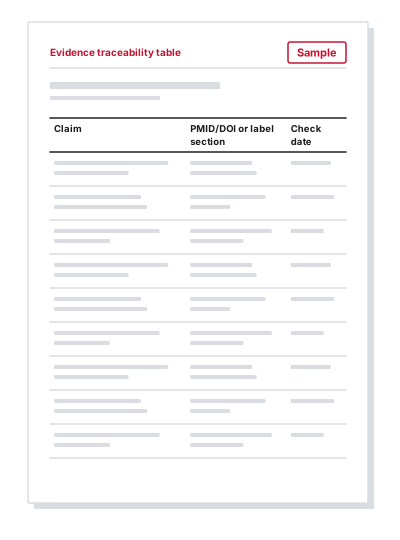
Evidence traceability table sample
Related services
02Medical Writing
Neurological function, activities of daily living and safety outcomes require clear measurement definitions and follow-up time points.
In traumatic brain injury research, for example, data collection must distinguish injury characteristics, intervention information and outcome assessment. Scale selection and use should match the study population and aims. Measures for different conditions cannot be interchanged simply because both fall within neurosurgery.
Manuscripts should describe assessors, assessment time points and missing data handling. Observational studies also need to describe baseline disease status, between-group differences and confounders, avoiding presenting adjusted associations as established causal relationships.
Related services
03Medical Writing
Patient-reported outcomes and clinical observations describe post-treatment status from different perspectives.
Orthopaedic studies may use patient-reported outcomes (PRO) to describe pain, function and quality of life. Patient-reported outcome measures (PROM) must match the body site, condition and assessment purpose. Interpretation of score changes must retain baseline status and observation time points.
Device-related documents must define intended purpose, study populations and evidence applicability. Scale results, complication records and device-related outcomes are presented separately; conclusions from published evidence do not directly replace evaluation of the device submitted for registration.
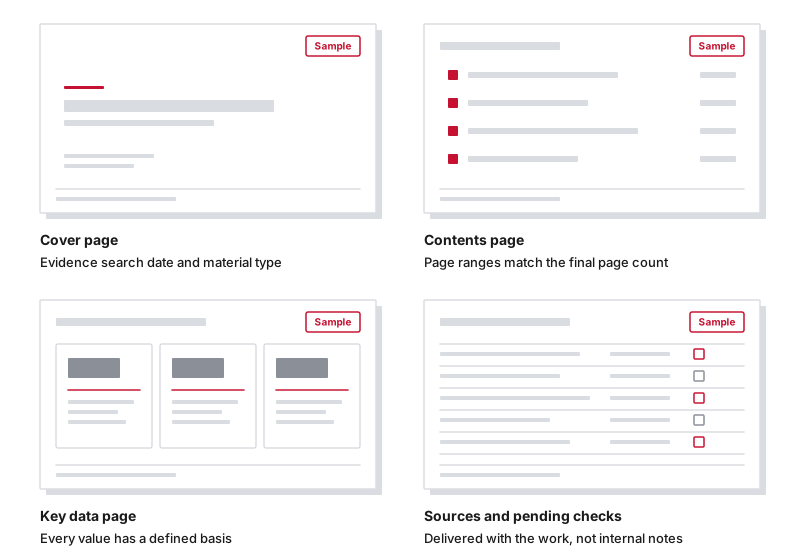
Scientific slide thumbnail sample set
Related services
04Medical Writing
Kidney function, albuminuria and clinical events have different measurement and interpretation criteria.
Chronic kidney disease (CKD) studies must describe cause, kidney function and albuminuria categories. Measurement methods, units and observation time points for estimated glomerular filtration rate (eGFR) and urine albumin-to-creatinine ratio (ACR) should remain consistent across protocols, statistical outputs and manuscripts.
For repeated measurements, distinguish single changes from follow-up trends; for event outcomes, define events and observation periods. Evidence reviews should describe the disease stages of included populations, avoiding direct extrapolation of results from one stage to all people with kidney disease.
Related services
05Medical Writing
Composite endpoints and their component events require separate presentation of definitions, results and interpretive scope.
Cardiovascular studies may use composite endpoints comprising multiple clinical events. Documents must list component events and adjudication rules and state whether analyses concern first events or another prespecified event definition. The overall result for a composite endpoint cannot be interpreted directly as the same effect on every component event.
Statistical reports must define the analysis population, start of follow-up, handling of censoring and multiple comparison arrangements. The text, abstract and figures/tables should consistently distinguish prespecified from exploratory analyses and retain uncertainty in effect estimates.
Related services
06Medical Writing
These links help locate services by research topic. Specific scope remains subject to the available materials, target documents and requirement confirmation form. For regulatory submission requests, we confirm engagement boundaries before providing a quotation.
We provide Medical information Q&A. See the Medical affairs and medical education page for service content and deliverables.
We provide a Publication plan service. See the Research publications page for service content and deliverables.
We provide evidence summaries, consultation materials, comment resolution records and a consensus report; we do not select experts or organise meetings.
Get started · Submit a request
Please provide the document type, quantity, project stage, intended use, available materials and deadline requirements. We first issue a requirement confirmation form, followed by an itemised quote and schedule.
This section describes our services. It does not concern any specific medicinal product and does not constitute drug advertising. The stated timelines, quality control and resolution procedures reflect standard working practices. Final deliverables, timelines, prices and each party's obligations are governed by the contract signed by both parties.
Writing and statistical support for research publications follows the recommendations of the International Committee of Medical Journal Editors (ICMJE) and Good Publication Practice 2022. Our contribution is disclosed in the acknowledgements in line with ICMJE and GPP 2022; we are not listed as authors. Funding sources are also disclosed truthfully. We do not promise publication outcomes.