
Medical Writing

Drug safety documents

Periodic benefit-risk evaluation reports (PBRER), development safety update reports (DSUR), risk management plans (RMP) and signal assessment reports support safety evaluation and risk management at different stages, for review by the client's pharmacovigilance, medical and regulatory teams.

Service scope
Writing periodic drug safety reports and safety documents, developing specialist scientific content from the same underlying evidence.

We do not collect, assess or submit individual case safety reports, or act as the party responsible for pharmacovigilance. Responsibility for document sign-off and submission rests with the client.

01 · Deliverables

Clear presentation of reporting intervals, cumulative evidence and risk judgements

Deliverables

Drug safety documents

Service scope
Writing periodic drug safety reports and safety documents, developing specialist scientific content from the same underlying evidence.
Deliverables

Draft PBRER/periodic safety update reports; draft DSURs; draft safety specification and pharmacovigilance plan sections of RMPs; and draft signal assessment reports.

Specifications and timeline
Document structures follow the relevant guidelines. Schedules are planned backwards from the data lock point and confirmed for each project.
Pricing basis
Priced per item. We first issue a requirement confirmation form, followed by an itemised quotation.

For patient safety event narratives in clinical studies, see the clinical study report page. We undertake writing, structural organisation and consistency review of these documents; responsibility for sign-off and submission rests with the client.

Schedules are confirmed with reference to the reporting interval, material readiness, target region requirements and the client's review arrangements.
02 · Content structure

Content priorities across safety documents

Figure 1 Content allocation across drug safety documents · Illustrative structurePBRERBenefit-risk analysisDSURSafety during developmentRMP sectionsSafety specification · PV planSignal assessment reportEvidence · review · conclusionFigure 1 Content allocation across drug safety documents · Illustrative structurePBRERBenefit-risk analysisDSURSafety during developmentRMP sectionsSafety specification · PV planSignal assessment reportEvidence · review · conclusion
Figure 1Content allocation across drug safety documentsIllustrative structure
Figure caption

Illustrative document structure, without safety data or product-specific conclusions.

PBRER
Product background and reporting interval, exposure and new safety information, signal and risk evaluation, benefit evaluation, integrated benefit-risk analysis and conclusions.
DSUR
Development progress, study and exposure information, new safety findings, overall safety assessment, important risks and conclusions.
RMP sections
The safety specification records important risks and missing information; the pharmacovigilance plan describes proposed safety monitoring and research activities.
Signal assessment report
Define the question for assessment, evidence sources, evaluation process and conclusions, retaining uncertainty and further information needs.

These content groups are illustrative and do not replace a formal table of contents. Our RMP deliverables are limited to drafts of the safety specification and pharmacovigilance plan sections; this does not extend to services for a complete risk management system.

03 · Work steps

Reporting cycles and data lock points

The data lock point (DLP) defines the cut-off for reporting materials. It is distinct from database lock and from the drafting or submission date.

  1. Report type and interval

    Define the target region, reporting start and end dates and document type, distinguishing interval information from cumulative information.

  2. Check materials and definitions

    Compile safety materials and statistical outputs supplied by the client, checking coverage, versions, denominators and definitions used in previous reports.

  3. Writing and cross-checking

    Organise the draft under the relevant guidelines, check consistency between text, summary tables and conclusions, and record material queries awaiting clarification.

  4. Review and sign-off handover

    Resolve review comments and prepare a controlled draft; the client is responsible for sign-off and submission.

The PBRER reporting interval and DLP are based on the international birth date (IBD), taking regional requirements into account; the DSUR annual reporting cycle is based on the development international birth date (DIBD). The date basis and content scope of each report type should be recorded separately.

Figure 2 Reporting interval and delivery milestones · Illustrative structurePBRER · IBDReporting intervalDLPMaterial compilationDraft reviewClient signs/submitsDSUR · DIBDReporting intervalDLPMaterial compilationDraft reviewClient signs/submitsDistinguish interval information from cumulative information.Figure 2 Reporting interval and delivery milestones · Illustrative structurePBRER · IBDReporting intervalDLPMaterial compilationDraft reviewClient signs/submitsDSUR · DIBDReporting intervalDLPMaterial compilationDraft reviewClient signs/submits
Figure 2Reporting interval and delivery milestonesIllustrative structure
Figure caption

Illustrative timing relationships, without specific dates or statutory submission periods; our writing timelines are confirmed for each project.

04 · Standards and guidance

Document types and applicable guidelines

International Council for Harmonisation of Technical Requirements for Pharmaceuticals for Human Use (ICH) guidelines provide document structures and basic principles; specific submission requirements must also be matched to the target region.

Document types and applicable guidelines
Standard and scopeVersion, content and purpose
PBRERICH E2C(R2), Periodic Benefit-Risk Evaluation Report (2012): section 2.8 covers reporting periodicity and the data lock point; section 3 covers report format and content.Full guideline.
DSURICH E2F, Development Safety Update Report (2010): section 2.2 covers annual periodicity and the data lock point; section 3 covers report content.Full guideline.
Safety specification and pharmacovigilance planICH E2E, Pharmacovigilance Planning (2004): section 2 covers the safety specification and section 3 covers the pharmacovigilance plan.Full guideline.
EU RMPEU Good Pharmacovigilance Practices (EU GVP), Module V, Risk Management Systems, Rev.2 (2017): section V.B.5 covers the safety specification and section V.B.6 covers the pharmacovigilance plan.Full guideline.
EU signal managementEU GVP Module IX, Signal Management, Rev.1 (2017): section IX.A.1.1 defines relevant concepts; section IX.B.3 and Figure IX.1 address signal validation and subsequent evaluation; section IX.B.5 addresses quality requirements.Full guideline.

05 · Samples and examples

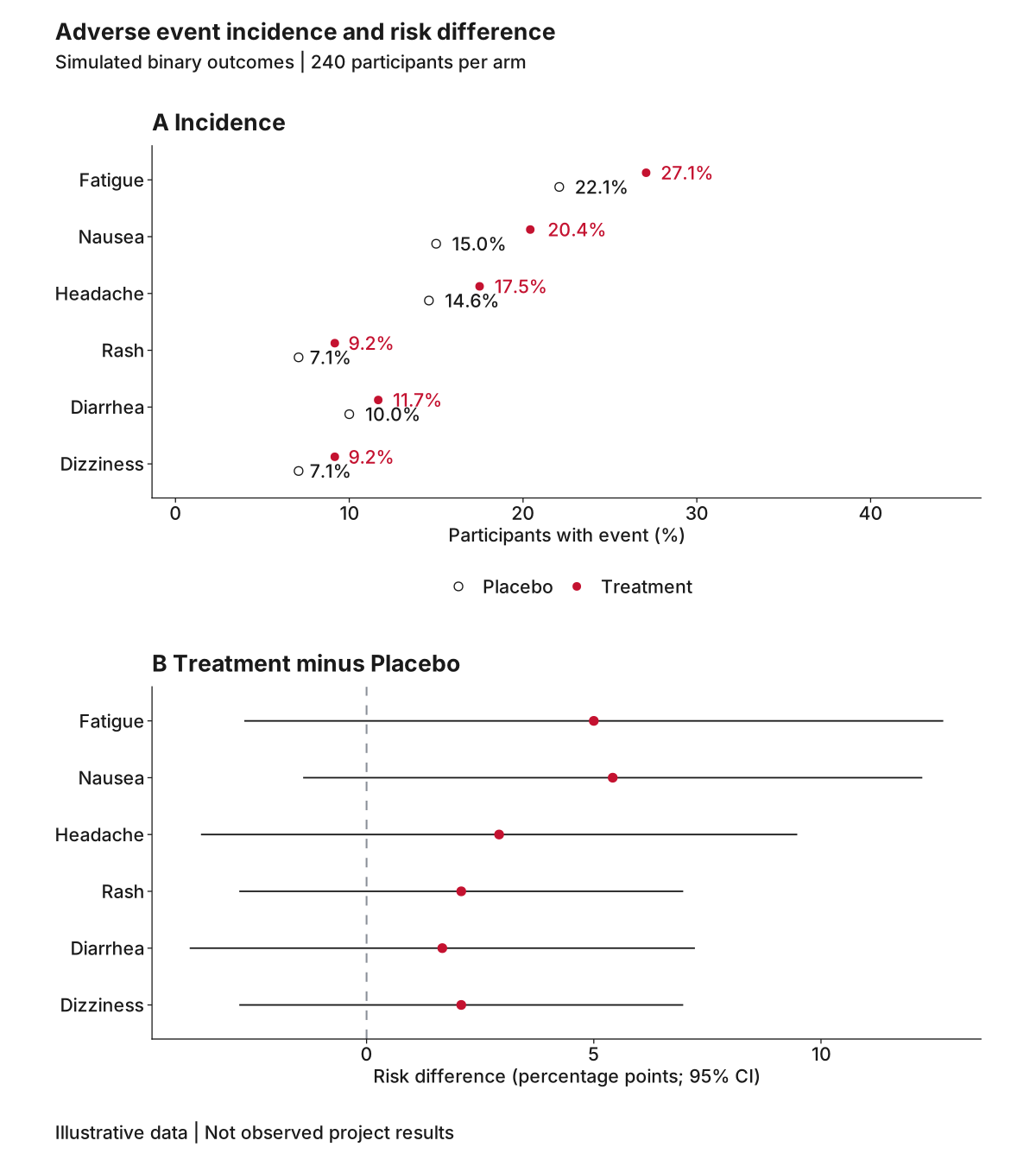
Example presentation of safety results

The example presents event rates alongside between-group differences; it is not a complete sample PBRER, DSUR or RMP.

Figure 3 Adverse event rates and risk differences · Illustrative data
Figure 3Adverse event incidence and risk differencesIllustrative data
Figure caption

The data are simulated. The treatment and placebo groups each contain 240 participants, with 6 adverse event categories shown; a participant may experience events in multiple categories. Fatigue rates are 27.1% and 22.1%, respectively, with a risk difference of 5.0 percentage points and a 95% Wald confidence interval of −2.7 to 12.7 percentage points. Events were generated by simulated binomial sampling without adjustment for multiple comparisons; they do not constitute real safety conclusions.

06 · Frequently asked questions

Frequently asked questions

Boundaries between periodic and individual case reports

We write the listed periodic reports and safety documents. We do not collect, assess or submit individual case safety reports, or act as the party responsible for pharmacovigilance.

RMP engagement scope

Deliverables comprise drafts of the safety specification and pharmacovigilance plan sections. A complete RMP includes other content; writing the sections listed here is not equivalent to establishing a complete risk management system or conducting all its activities.

Shared materials for PBRER and DSUR

The two document types may share some underlying materials, but differ in purpose, date basis and report content. One cannot serve as the other simply by changing its title.

Submission responsibility

We undertake writing, structural organisation and consistency review; responsibility for sign-off and submission rests with the client.

Get started · Submit a request

Submit a medical writing request

Please provide the document type, target region, reporting interval, data lock point, status of available materials and review arrangements.

Submit a medical writing requestWe first issue a requirement confirmation form, followed by an itemised quotation and schedule. Reply within 24 hours (business days first). · contact@yantohealth.cn