Medical Writing

Clinical development and regulatory affairs

We integrate study materials, analysis outputs and clinical interpretation into documents for review by medical, statistical and regulatory departments.

Relevant departments
Departments responsible for nonclinical research, clinical development, medical affairs, regulatory affairs, drug safety, health economics and medical device clinical evaluation.

We undertake writing, structural organisation and consistency review. Responsibility for signing and submitting documents rests with the client. The scope of regulatory submission work is confirmed before quotation.

01Medical Writing

Service scope and deliverables

Each service below specifies its scope, deliverables, specifications and timeline, and pricing basis.

Clinical trial protocols and informed consent forms (Protocol/ICF)

Service scope
Writing clinical trial protocols and amendments, and informed consent forms (ICF). Where protocol changes affect other documents, the relevant content should be checked for consistency. The clinical study report (CSR) should accurately describe actual conduct and protocol deviations.
Deliverables
Draft clinical trial protocols and amendments, and ICF.
Specifications and timeline
Clinical trial protocols are checked against appendix B of the International Council for Harmonisation of Technical Requirements for Pharmaceuticals for Human Use (ICH) Guideline for Good Clinical Practice E6(R3) (2025); ICF are checked against annex 1, section 2.8. Lead writing for an initial investigational new drug (IND) clinical trial protocol is recommended as a joint engagement. Timeline confirmed for each project.
Pricing basis
We confirm the scope of the engagement before quotation.

Investigator's brochure (IB): first edition and updates

Service scope
Writing a first-edition investigator's brochure (IB), bringing together nonclinical pharmacology, toxicology and pharmacokinetic data and available clinical information; annual updates to an existing version, incorporating safety information.
Deliverables
First-edition IB draft; IB updates, including updated background evidence.
Specifications and timeline
IB checked against ICH E6(R3) (2025), appendix A. The first edition is recommended as a joint engagement. Timeline confirmed for each project.
Pricing basis
We confirm the scope of the engagement before quotation.

Nonclinical documents (CTD 2.4/2.6 and nonclinical study reports)

Service scope
Writing Common Technical Document (CTD) nonclinical overviews and nonclinical written and tabulated summaries for clinical trial and marketing authorisation applications; writing support for nonclinical study reports based on study reports and data supplied by the client.
Deliverables
Draft CTD 2.6 nonclinical written and tabulated summaries; draft CTD 2.4 nonclinical overview (recommended as a joint engagement); draft nonclinical study reports.
Specifications and timeline
Content follows modules 2.4 and 2.6 of ICH M4S(R2) (2002). Nonclinical study reports are reviewed and signed by the study director at the research institution, which retains GLP compliance responsibility. We do not conduct experimental (laboratory or animal) studies. Timeline confirmed for each project.
Pricing basis
We confirm the scope of the engagement before quotation.

Clinical study reports and safety event narratives (CSR)

Service scope
Writing CSR and patient safety event narratives.
Deliverables
Draft CSR and patient safety event narratives.
Specifications and timeline
Content follows sections 1–16 of ICH Structure and Content of Clinical Study Reports E3 (1995), with section 16 covering appendices; safety event narratives are checked against section 12.3.2. Timeline confirmed for each project.
Pricing basis
We confirm the scope of the engagement before quotation.

CTD clinical documents and responses to regulatory questions (CTD 2.5/2.7)

Service scope
Writing CTD clinical overviews and clinical summaries, and supporting responses to regulatory questions.
Deliverables
Draft CTD 2.7 clinical summary; draft CTD 2.5 clinical overview (recommended as a joint engagement); supporting drafts for responses to regulatory questions (recommended as a joint engagement).
Specifications and timeline
Content follows modules 2.5 and 2.7 of ICH M4E(R2) (2016). The clinical overview is approximately 30 pages and the clinical summary usually 50–400 pages; length depends on the complexity of the materials and is not a fixed deliverable page count. CTD 2.5 requires a critical analysis of the overall clinical development programme and is recommended as a joint engagement. Timeline confirmed for each project.
Pricing basis
We confirm the scope of the engagement before quotation.

Regulatory meeting briefing packages

Service scope
Writing and compiling meeting application materials; attendance by our staff is not included.
Deliverables
Draft regulatory meeting briefing package.
Specifications and timeline
Timeline confirmed for each project.
Pricing basis
We confirm the scope of the engagement before quotation.

Drug safety

Service scope
Writing periodic drug safety reports and safety documents, developing specialist scientific content from the same underlying evidence.
Deliverables
Draft periodic benefit-risk evaluation report (PBRER)/periodic safety update report; draft development safety update report (DSUR); draft safety specification and pharmacovigilance plan sections of the risk management plan; draft signal assessment report. For patient safety event narratives in clinical studies, see item 4 in this category.
Specifications and timeline
PBRER follows the chapter structure specified in ICH E2C(R2), with reporting intervals and data lock points based on the product's international birth date. DSUR follows the structure specified in ICH E2F, with annual reporting periods based on the development international birth date. Timelines are planned backwards from the data lock point and confirmed for each project.
Pricing basis
Priced per item. We first issue a requirement confirmation form, followed by an itemised quotation.

We do not collect, evaluate or submit individual case safety reports, nor do we act as the entity responsible for pharmacovigilance.

Health economics

Service scope
We interpret costs and health outcomes within the same framework, explicitly stating the evaluation perspective, cost scope and model assumptions, and retaining uncertainty.
Deliverables
Health economic evaluation protocol (specifying perspective, comparators, cost scope, time horizon and discounting); cost-effectiveness/cost-utility analysis report; budget impact analysis report; systematic literature review of economic evaluation parameters such as costs and utilities; journal manuscript on the health economic evaluation, with a Consolidated Health Economic Evaluation Reporting Standards (CHEERS 2022) checklist; executable health economic model files (Excel or R, as requested by the client); draft economic sections of a value dossier.
Specifications and timeline
Reports are checked item by item against CHEERS 2022; systematic reviews follow Preferred Reporting Items for Systematic Reviews and Meta-Analyses (PRISMA) 2020. Timeline confirmed for each project.
Pricing basis
We first issue a requirement confirmation form, followed by an itemised quotation.

Medical device clinical evaluation (CER/PMCF)

Service scope
Clinical evidence searches, appraisal and writing for device documents such as clinical evaluation reports (CER) and post-market clinical follow-up (PMCF), with attention to consistency between images, results and interpretation.
Deliverables
Clinical evaluation plan (CEP); literature search strategy and search report; CER; PMCF plan and PMCF evaluation report; summary of safety and clinical performance (SSCP), with applicability determined under article 32 of the EU Medical Device Regulation and its exceptions; clinical evaluation materials for registration in China.
Specifications and timeline
CER evaluators are appointed by the client and sign the evaluation report; we undertake evidence searches, appraisal and writing. Timeline confirmed for each project.
Pricing basis
We first issue a requirement confirmation form, followed by an itemised quotation.

02Medical Writing

Scope and responsibilities

Can take on

5
  • Clinical study reports

    Writing, structural organisation and consistency review.

  • Investigator's brochure (IB) updates

    Annual updates to an existing version, incorporating safety information.

  • Common Technical Document module 2.7 clinical summary

    Drafts organised according to the relevant module.

  • Regulatory meeting briefing packages

    Writing and compiling meeting application materials; attendance by our staff is not included.

  • CTD 2.6 nonclinical summaries and nonclinical study report writing support

    Writing based on study reports and data supplied by the client, without conducting additional experiments; nonclinical study reports are reviewed and signed by the study director at the research institution.

Recommended as a joint engagement

5
  • Lead writing for the initial IND clinical trial protocol

    Completed jointly with the client's regulatory/medical department or a partner with relevant experience.

  • Common Technical Document module 2.5 clinical overview

    Requires critical analysis of the overall clinical development programme.

  • Investigator's brochure (IB): first edition

    Requires synthesis of nonclinical and early clinical materials into an overall assessment; joint work with the client's nonclinical and medical departments is recommended.

  • CTD 2.4 nonclinical overview

    Requires an overall critical analysis of nonclinical studies; a joint engagement is recommended.

  • Supporting drafts for responses to regulatory questions

    Responses have tight deadlines and must align with the overall submission strategy; joint work with the client's regulatory department or a partner with relevant experience is recommended.

Not taken on

3
  • Electronic Common Technical Document (eCTD) publishing and submission

    Document writing support does not include publishing or submission.

  • Formal communication with regulatory review agencies and in-person defence

    Does not include attendance by our staff or formal communication on the client's behalf.

  • Design and conduct of experimental studies, and GLP compliance responsibility

    We do not conduct experimental (laboratory or animal) studies. GLP compliance responsibility rests with the research institution.

For a first engagement, we recommend starting with a single document or chapter, reviewed and signed by the client's regulatory or medical department. We can also undertake writing as a consortium member or subcontractor to a lead contract research organisation (CRO).

This is an area we are developing. For NMPA regulatory submission projects: We do not yet have a prior track record that we can cite publicly. If a project requires evidence of comparable submissions from suppliers, the client should state this when requesting a quotation.

Drug safety document services do not include collecting, evaluating or submitting individual case safety reports, and we do not act as the entity responsible for pharmacovigilance. Medical device clinical evaluators are appointed by the client and sign the evaluation report; we undertake evidence searches, appraisal and writing.

Nonclinical documents follow modules 2.4 and 2.6 of ICH M4S(R2) (2002).

03Medical Writing

Typical workflow

Regulatory documents start with material versions, analysis definitions and signing responsibilities; different document types follow different checking pathways.

Clinical trial protocols and informed consent forms

Define objectives and material versions → Organise the protocol structure → Check eligibility criteria, endpoints and study procedures → Cross-check informed consent content → Medical and regulatory review → Client confirms the intended version.

Investigator's brochure: first edition and updates

Confirm first-edition or update scope → Compile nonclinical and available clinical materials → Organise first-edition content or mark update locations → Check safety information and clinical interpretation → Review and confirm the version.

Nonclinical documents

Confirm commissioned materials and document scope → Check study reports and data sources → Organise drafts by applicable module → Check cross-document consistency and resolve review comments → Review and signature by the study director at the research institution or the client

Clinical study reports and safety event narratives

Confirm versions of the protocol, statistical analysis plan and tables, listings and figures (TLF) → Map chapters to result sources → Write the main text and event narratives → Check populations, denominators, values and event timelines → Resolve review comments → Client review and signature.

Common Technical Document and responses to regulatory questions

Define the module or regulatory questions → Review evidence across studies → Integrate the clinical summary or overview → Check cross-document consistency → Review and prepare supporting response drafts.

Regulatory meeting briefing packages

Define meeting objectives and discussion questions → Compile background materials and the rationale for questions → Prepare the briefing package → Internal review and revision → Hand over to the client for formal communication.

Drug safety documents

Confirm reporting interval and data lock point → Compile source materials → Organise safety and benefit-risk content → Check cumulative and interval reporting definitions → Client review, signature and submission.

Health economics documents

Define the decision question and evaluation perspective → Compile parameter sources → Develop the model and analyses → Assess uncertainty → Check consistency between model, report and conclusions.

Medical device clinical evaluation

Define device scope and evaluation plan → Develop the search strategy → Screen and appraise evidence → Prepare clinical evaluation and post-market clinical follow-up documents → Review and signature by client-appointed evaluators.

These steps describe document preparation and do not extend engagement boundaries. The project scope determines the specific combination of modelling, searches, analysis and writing.

Package engagement

Clinical documentation projects

The work package includes materials integration and document development; medical, statistical and specialist review; comment resolution and a controlled final version. Input materials, interim deliverables and acceptance criteria are agreed around the client's actual work package. For regulatory submission requests, we confirm the scope before quotation.

04Medical Writing

Applicable standards and document mapping

The provisions below identify document content requirements. Projects must separately confirm the requirements applicable in the target region; citing international guidelines does not imply that we hold regulatory submission credentials.

Standard names, versions and locations
Applicable standards and document mapping
DocumentStandard names, versions and locations
Clinical trial protocols, informed consent forms and investigator's brochuresICH Guideline for Good Clinical Practice E6(R3), 2025 final version and corrigendum dated 2025-10-24; appendix B covers protocols, appendix A investigator's brochures, annex 1 section 2.8 informed consent, and section 3.6.6 sponsor responsibilities after delegation to service providers.
Clinical study reports and event narrativesICH Structure and Content of Clinical Study Reports E3, 1995; sections 1–16 cover overall organisation, and section 12.3.2 covers narratives of deaths, other serious adverse events and certain other significant adverse events.
Common Technical Document clinical overview and clinical summaryICH M4E(R2), Revision of M4E Guideline on Enhancing the Format and Structure of Benefit-Risk Information in ICH Efficacy, 2016; modules 2.5 and 2.7, with benefit-risk analysis in 2.5.6.
Periodic benefit-risk evaluation reportICH Periodic Benefit-Risk Evaluation Report E2C(R2), 2012; section 2.8 covers reporting intervals and data lock points, and section 3 report content.
Development safety update reportICH Development Safety Update Report E2F, 2010; section 2.2 covers reporting intervals and data lock points, and section 3 report content.
Health economic evaluation papersConsolidated Health Economic Evaluation Reporting Standards (CHEERS 2022), the 28-item checklist in table 1 of the 2022 statement.
Nonclinical documentsICH M4S(R2) (2002): The Common Technical Document for the Registration of Pharmaceuticals for Human Use: Safety — Nonclinical Overview and Nonclinical Summaries of Module 2; Organisation of Module 4; modules 2.4 and 2.6.

ICH E6(R3) final version and corrigendum;ICH E3;ICH M4E(R2);ICH E2C(R2);ICH E2F;CHEERS 2022.

05Medical Writing

Samples and presentation examples

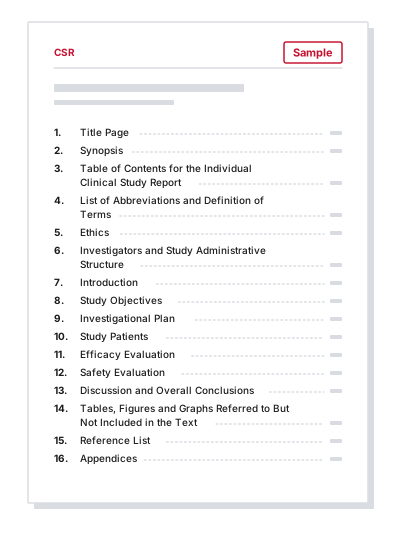
Clinical study report contents; illustrative sample
Figure 2Clinical study report contentsIllustrative sample
Figure caption

Illustrative sample. Shows chapter organisation; it does not represent a completed regulatory submission document.

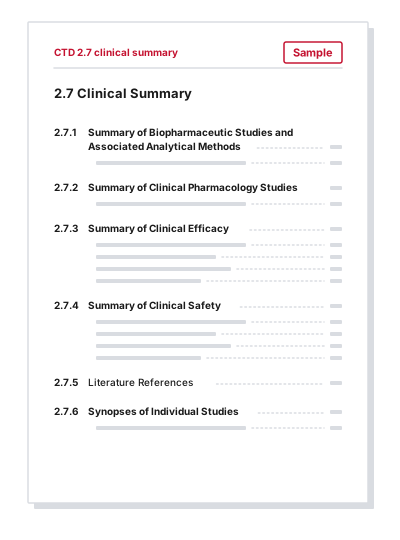
Common Technical Document module 2.7 structure; illustrative sample
Figure 3Common Technical Document module 2.7 structureIllustrative sample
Figure caption

Illustrative sample. Shows clinical summary structure; it does not represent a regulatory submission track record.

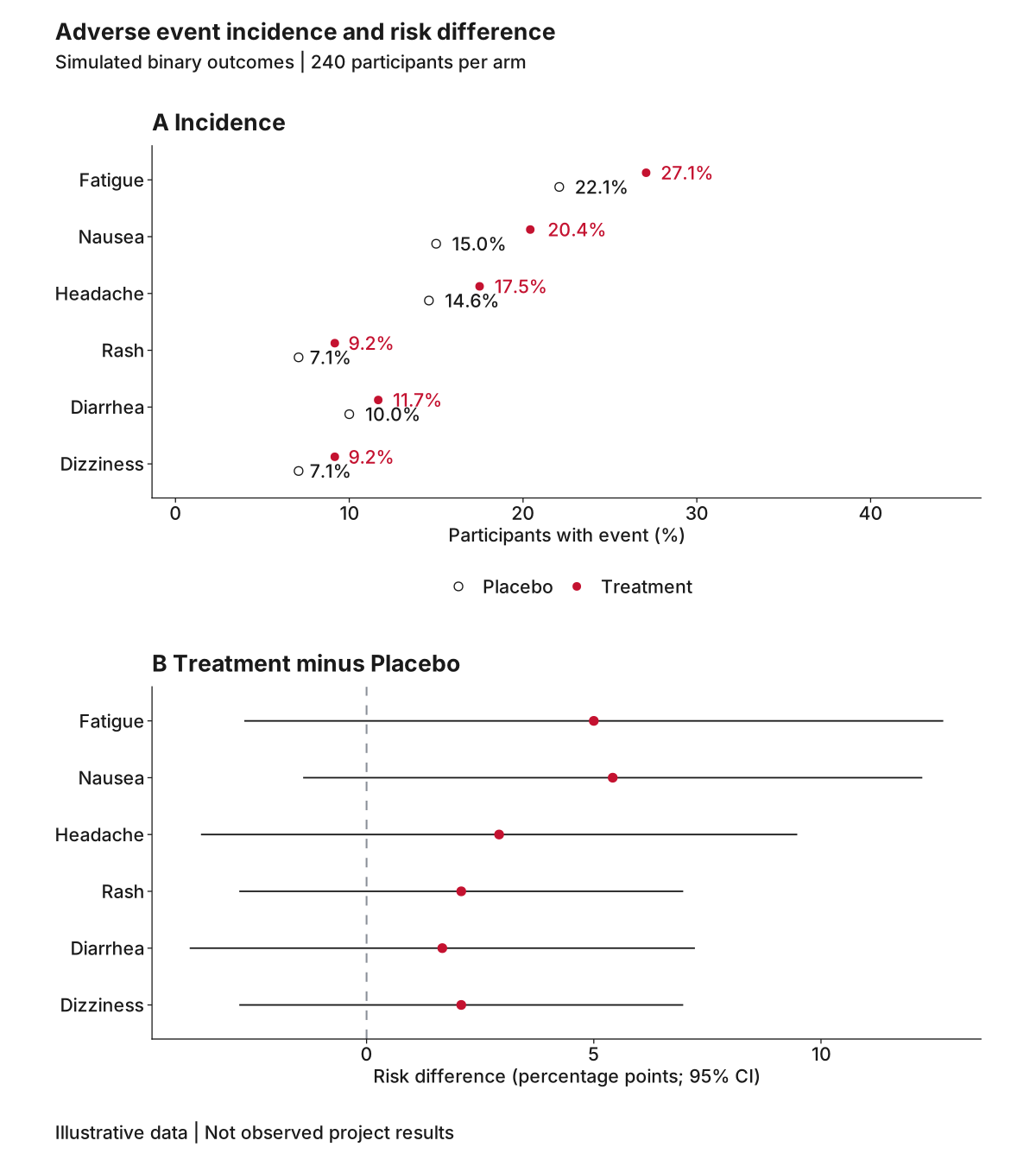
Adverse event incidence and risk differences; Illustrative data
Figure 4Adverse event incidence and risk differencesIllustrative data
Figure caption

The data are simulated. The treatment and placebo groups each have 240 participants; 6 adverse event categories are shown, and one participant may experience multiple categories. Fatigue incidence is 27.1% and 22.1%, respectively, with a risk difference of 5.0 percentage points and a 95% Wald confidence interval of −2.7 to 12.7 percentage points. No adjustment for multiple comparisons was made. These are not actual safety results.

06Medical Writing

Frequently asked questions

Single documents and joint engagements

For a first engagement, we recommend starting with a single document or chapter. Lead writing for an initial IND clinical trial protocol, CTD 2.5 clinical overview, first-edition investigator's brochure (IB), CTD 2.4 nonclinical overview and supporting drafts for responses to regulatory questions are recommended as joint engagements. See the scope on this page for services we can take on and those not taken on.

Responsibilities for writing and formal submission

We undertake writing, structural organisation and consistency review. Responsibility for signing and submitting documents rests with the client. We do not currently undertake eCTD publishing and submission, formal communication with regulatory review agencies or in-person defence.

Drug safety documents versus pharmacovigilance operations

We undertake the agreed drug safety document writing. We do not collect, evaluate or submit individual case safety reports, nor do we act as the entity responsible for pharmacovigilance.

Delivery of health economic models

The current delivery scope includes executable health economic model files in Excel or R, as requested by the client. The requirement confirmation form specifies the models and reports included.

Clinical evaluation in China and evaluators

The service scope includes clinical evaluation materials for registration in China. Clinical evaluators are appointed by the client and sign the evaluation report; we undertake evidence searches, appraisal and writing.

Verification of previous regulatory submissions

For NMPA regulatory submission projects: We do not yet have a prior track record that we can cite publicly. Samples, reproductions of public data and company-wide project counts do not constitute evidence of comparable regulatory submissions.

Protocol completeness and the impact of amendments

A protocol must contain more than chapter headings: study objectives, design, participant protection and analysis arrangements must form complete content suitable for review. After amendments, relevant informed consent materials and applicable content in subsequent reports should be checked. Facts from completed studies must not be retrospectively rewritten because a protocol has been updated.

Get started · Submit a request

Submit a medical writing request

Please provide document types, development or submission stage, target region, material versions and completeness, review and signing responsibilities, and deadlines. We first issue a requirement confirmation form, followed by an itemised quotation and schedule.

Submit a medical writing requestReply within 24 hours (business days first) · contact@yantohealth.cn