
Basic project tracking
Monthly email progress reports for small projects with a single method and a clear data structure. Excludes project management system (PMS) dashboard access and independent QC reruns. From ¥12,800.
Clinical Research Services
This supports managed service packages and is not sold separately. Full-service management includes reports every Friday, Multicentre / randomised controlled trial (RCT) includes weekly reports, and Collaboration starter includes monthly email reports. Key decisions and delivery records are retained in writing.
Package support · See pricing for full features and fees
01 Clinical Research
A central problem in research project management is limited visibility: clients struggle to track progress, analysts struggle to clarify expectations, and the two sides understand milestones differently. We therefore use the established Agile project management approach from software engineering to manage research as projects with defined deliverables.
Every milestone has explicit acceptance criteria, and every key decision has a written record. Reporting frequency depends on the package: every Friday for Full-service management, weekly for Multicentre / RCT, and monthly by email for Collaboration starter. Reports and the milestone system proactively share progress, so clients can understand the current status without asking separately.
Complex projects such as multicentre RCTs also include monthly risk reviews to identify data quality risks and deviations in analytical strategy early. All process assets (code + data dictionary + decision log) are delivered in full, leaving clients with a complete auditable record at project close.
Monthly email progress reports for small projects with a single method and a clear data structure. Excludes project management system (PMS) dashboard access and independent QC reruns. From ¥12,800.
Friday reports + milestone dashboard + PMS Mini Program access + independent QC rerun + complete deliverable package. For medium and large projects with multiple methods or outcomes that need detailed refinement to journal guidelines. From ¥25,800.
Adds to Full-service management: monthly risk reviews + independent statistician review + data safety monitoring board (DSMB) report support + multicentre case report form (CRF) consistency audits. For registered clinical trials, multicentre observational studies and projects requiring statistical reports for ethics committees or journals. Custom quote.
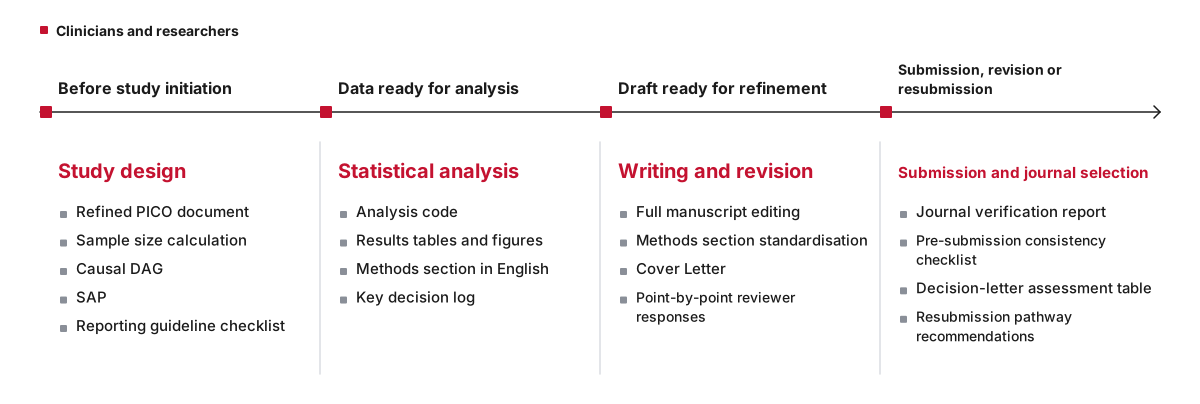
Before study initiation: study design; existing data: statistical analysis; existing manuscript: writing and revision; submission, revision or submission to another journal: submission and journal selection.
See the pricing page for a full comparison of the three tiers.
02 Clinical Research
The following recreates an internal PMS screenshot; clients can view the same information in the Mini Program.
Project identifiers, dates and progress on the dashboard are illustrative and do not correspond to any actual project.
| Task records | Status |
|---|---|
| Data cleaning + missing value imputation using multiple imputation by chained equations (MICE) | Completed |
| Propensity score matching (PSM) · Standardised mean difference (SMD) < 0.1 verified | Completed |
| Main Cox analysis + 3 sets of sensitivity analyses | In progress |
| QC rerun + deliverable packaging | Not started |
03 Project schedule
Typical 12-week project timeline template
From kick-off to submission preparation, the diagram has 9 time blocks. Of these, 3 require sign-off by both the project lead and QC reviewer: Primary Modelling, Figure Package and Submission Prep. Clients can check each stage's status in real time in the PMS.
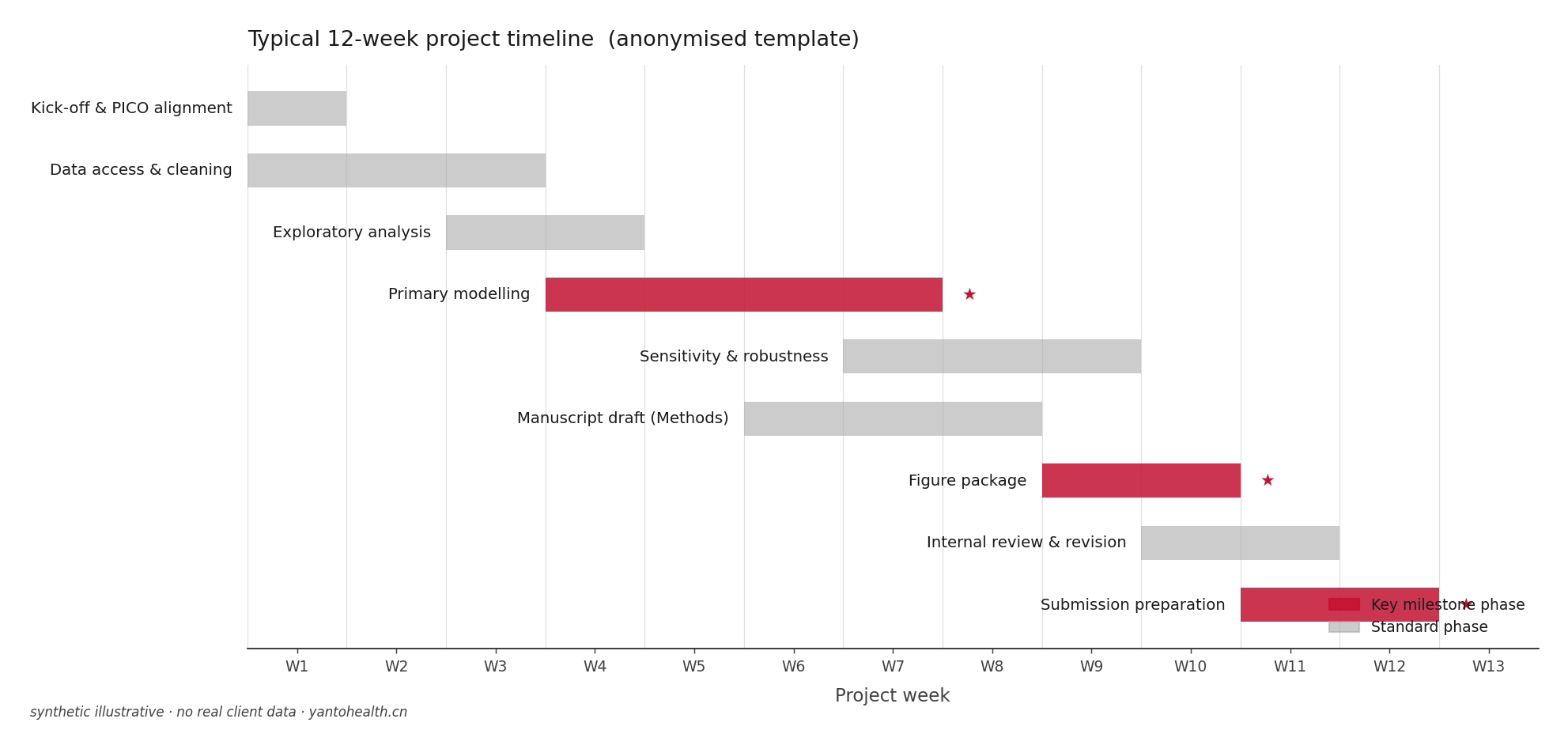
Illustration · Synthetic Illustrative data, with no actual project or patient data (Synthetic illustrative). ★ marks sign-off by both the project lead and QC reviewer.
W1 Kick-off → W2-3 Data processing (Data) → W4-7 Model analysis (Modelling) ★ → W6-8 Manuscript draft (Draft) → W10-11 Figures (Figure) ★ → W11-12 Submission preparation (Submit) ★
04 Project milestones
After clients submit study information (research question + basic data details), we reply within 24 hours (business days first), providing methodological feasibility feedback and a recommended service package in the first response. Assessment is free; if the project is judged infeasible, the process ends without any fee. This step screens projects, with quotes provided afterwards.
Based on the actual data, we produce a population, intervention, comparison and outcome (PICO) table + draft statistical analysis plan (SAP). The SAP covers primary outcomes, main analysis methods, sensitivity analyses and subgroup analyses. The project lead and QC reviewer both sign off, and modelling starts once the client has no objections. Work does not begin before agreement, to avoid later rework.
Work proceeds in this order: data cleaning → MICE imputation → main analysis → sensitivity analyses → independent QC rerun (MICE, sensitivity analyses and independent QC reruns apply to Full-service management and above; Collaboration starter uses a project lead self-check). Full-service management receives Friday reports (Multicentre / RCT weekly reports; Collaboration starter monthly email reports). Key decisions, including model selection and sensitivity analysis plans, require asynchronous client confirmation before proceeding. Timelines depend on complexity: a single-method, single-outcome project takes approximately 4–8 weeks (Collaboration starter, from receipt of complete data); Multicentre / RCT follows the contractual target of 6–12 months from receipt of complete data for the entire project.
Checklist terminology: Portable Network Graphics (PNG), Portable Document Format (PDF), Methods section (Methods), submission cover letter (Cover Letter), Strengthening the Reporting of Observational Studies in Epidemiology (STROBE), and Consolidated Standards of Reporting Trials (CONSORT).
After QC verification (independent rerun for Full-service management and above; project lead self-check for Collaboration starter), we package annotated analysis code + final dataset + figures in PNG/PDF + revised Methods text + cover letter + STROBE/CONSORT self-checklist + submission guidance. All materials are delivered through an encrypted channel for client review.
After a journal decision letter is received, we provide point-by-point response strategies for statistical issues, up to 3 times (Full-service management and Multicentre / RCT). Statistical issues unresolved after 3 revisions or appeals are handled underClause 2 of the Refund Policy; rejection for non-statistical reasons, such as novelty or journal fit, is outside revision support. Revision support is bundled with main analysis delivery and is not charged separately.
05 Clinical Research
Issued every Friday for Full-service management, recording specific outputs, schedule deviations and items awaiting confirmation.
06 Clinical Research
During data cleaning, CRF data from each centre are audited for field completeness and coding consistency to identify sources of centre effects and decide whether centre should enter the model as a covariate.
After the main analysis, an independent QC statistician reproduces the primary outcomes using the same dataset without consulting the main analysis code. Deliverables can be packaged only once results agree; discrepancies must be traced.
A monthly risk review, conducted asynchronously in writing, systematically assesses data quality risks, analytical strategy deviations, timeline deviations and the impact of patient recruitment on sample size. Early alerts avoid discovering unusable data only after analysis begins.
For trials with a data safety monitoring board (DSMB), we provide interim analysis report templates, α-spending function specifications (O'Brien-Fleming / Pocock boundaries) and DSMB report drafting support.
07 Clinical Research
If a key variable has >20% missingness during cleaning, an immediate weekly report alert outlines the trade-offs between MICE imputation, complete-case analysis and sensitivity analysis. Work proceeds after client confirmation; data are not processed without prior notification or explained only afterwards.
Minimum subgroup sample size requirements are assessed at the statistical analysis plan (SAP) stage. If a subgroup cannot support meaningful power, the client is informed early and the plan adjusted by combining subgroups, using descriptive analysis only or dropping that subgroup, rather than discovering the problem during modelling.
If actual data differ from the description agreed during planning, such as unusual follow-up distributions or unclear control group definitions, modelling pauses immediately. Analysis boundaries are reconfirmed before proceeding. Timelines are extended if necessary; analyses without a meaningful basis are not undertaken.
For complex models such as Fine-Gray competing risk or mixed-effects models, convergence problems are documented, alternative parameterisations tried and the client informed in the weekly report. Alternative models are listed in advance in the SAP to avoid improvised changes.
Before submission, we check figure formatting against the target journal's requirements for fonts, DPI and captions. Both PDF and PNG are delivered, with code retained for redrawing. Revisions due to figure formatting are redrawn free of charge within scope.
All key decisions have written records in the PMS and do not depend on any individual's memory. If the project lead changes, the incoming person can reconstruct the full context from decision records, preserving delivery continuity. This is a core design principle of our project management system.
08 Clinical Research
No. Collaboration is asynchronous by default, with reporting frequency by package: every Friday for Full-service management, weekly plus monthly risk reviews for Multicentre / RCT, and monthly by email for Collaboration starter. Decisions requiring client confirmation are listed in reports and can be answered at any time. Apart from monthly Multicentre / RCT risk reviews, live discussions, such as a pre-launch confirmation meeting, are arranged as needed, with no mandatory standing meetings. Most clients are clinicians, so collaboration is designed around their schedules.
Full-service management (from ¥25,800) and Multicentre / RCT (custom quote) both include complete project management: weekly reports, milestones and PMS dashboard access. Collaboration starter includes basic tracking through monthly email reports; clients needing full weekly reporting can upgrade to Full-service management.
All key decisions have written records in the PMS and do not depend on a particular person's memory. If the project lead changes, the incoming person can reconstruct the full background from decision records, preserving delivery continuity. This is a core design principle of our project management system.
Items awaiting confirmation in weekly reports usually allow 3–5 business days. Unanswered items are flagged again in the next weekly report, or monthly report for Collaboration starter. Disputed analytical decisions are not advanced unilaterally while client confirmation is pending.
Available with Full-service management and Multicentre / RCT through the Yanto Health WeChat Mini Program → My projects. The Mini Program shows milestone progress, the latest weekly report summary and items awaiting confirmation. For full historical records, contact us for web access.
Yes. Full-service management and Multicentre / RCT include up to 3 revisions within scope, limited to statistical issues explicitly raised by reviewers in journal decision letters and related to our analytical methods. Issues unresolved after 3 revisions or appeals are handled under the Refund Policy , Clause 2, and the service agreement. Collaboration starter excludes reviewer response guidance, which can be added per round. Rejections caused by underlying data flaws, requests outside statistical methods and reviewer requests for additional data collection are excluded. Rejections for non-statistical reasons, such as insufficient novelty or journal fit, are also outside revision support; we can provide submission strategy advice.
Get started · Methodology assessment
Submit your research question, available data and intended outputs. Reply within 24 hours (business days first), with feasibility feedback, viable statistical approaches and a recommended package in our first response.
Our involvement in a paper is disclosed truthfully: where our staff meet the authorship criteria of the International Committee of Medical Journal Editors (ICMJE), they are listed as authors under our company's real affiliation; any other contribution is stated in the acknowledgements. Acceptance is decided by the journal editorial office and peer review. We do not promise publication outcomes.