
Clinical Research Services

Study design

Analysis plans are developed around PICO (population, intervention, comparison and outcome), endpoints, confounders and sample size.

Clinicians and researchersBefore study initiationDuring data collectionAfter database lockAfter the first rejection

01Clinical Research Services

Deliverables and study types

Refined PICO document

Turns an unresolved clinical question into a testable scientific hypothesis. Exposure definitions (including measurement methods and time windows), primary and secondary outcomes, follow-up windows, and inclusion and exclusion criteria are confirmed in writing, with formatting informed by EQUATOR reporting guidelines. The refined PICO document underpins all other deliverables; without a clear PICO, sample size estimation and the SAP lack a foundation.
Sample size calculation report

Using effect size estimates (published values or the minimum clinically important difference), power (80% by default, with 90% available for multicentre RCTs), two-sided α=0.05 and expected loss to follow-up, PASS produces a formal calculation report. It explains the effect size source and parameter choices and can accompany ethics committee submissions; some journals also require the software version in the Methods section.

Causal directed acyclic graph (DAG)

Identifies confounders, mediators and colliders and provides a minimally sufficient adjustment set, avoiding both overadjustment (effect attenuation) and underadjustment (residual confounding). The DAG can be included as a supplementary figure; methodological literature recommends reporting the DAG used. An editable version is produced using DAGitty or ggdag (an R package).

Statistical analysis plan (SAP)

Includes the rationale for the main analysis model, prespecified sensitivity analyses (at least 3 types), a prespecified subgroup analysis list, missing data strategies and their underlying assumptions of missing completely at random (MCAR), missing at random (MAR) or missing not at random (MNAR). All items are confirmed in writing and stored with timestamps in the project management system (PMS). The SAP can support preregistration on ClinicalTrials.gov or OSF; preregistration is optional, with format requirements specified separately.

Study protocol documents

Each stage ends with its corresponding deliverables, including study protocol documents, analysis code, figure source files or draft responses to reviewers.

02Clinical Research Services

Specifications, timelines and pricing

Study design

When it applies

Clinicians and researchers

  • Before study initiation
  • During data collection
  • After database lock
  • After the first rejection
Deliverables

Refined PICO document, sample size calculation report, causal directed acyclic graph (DAG), SAP and reporting guideline checklist.

Specifications and timelines

Standard turnaround is 3–7 business days, depending on design complexity. A single-centre retrospective cohort usually takes 3 days; a multicentre randomised controlled trial (RCT) or network meta-analysis usually takes 5–7 days.

Pricing basis

Study design is included in Full-service management (from ¥25,800); the pricing page specifies PICO refinement and sample size calculation. Multicentre / RCT includes everything in Full-service management.

Deliverables depend on the selected services and package. Sensitivity analyses and independent reruns by a QC reviewer are included in Full-service management and higher packages; for Collaboration starter, the project lead performs a pre-delivery self-check.

Pricing basis

Study design is included in Full-service management (from ¥25,800); the pricing page specifies PICO refinement and sample size calculation. Multicentre / RCT includes everything in Full-service management. Collaboration starter (from ¥12,800) excludes study design, which can be commissioned separately and quoted per item, with fees listed before the contract is signed. For clients with an existing analysis plan, we can assess whether full study design or only SAP review and strengthening is needed.

03Clinical Research Services

Anonymised study design excerpts

We can provide anonymised excerpts from comparable study design documents. A complete plan tailored to the client's data is issued after the free assessment discussion.

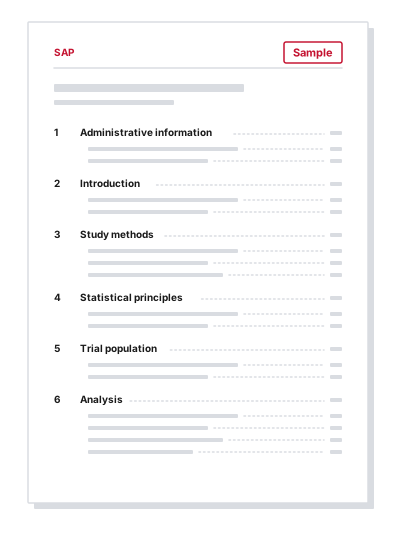
Statistical analysis plan (SAP) contents page sample
Figure 1Statistical analysis plan (SAP) contents page sampleSample illustration
Figure caption

Illustrative SAP contents page layout.

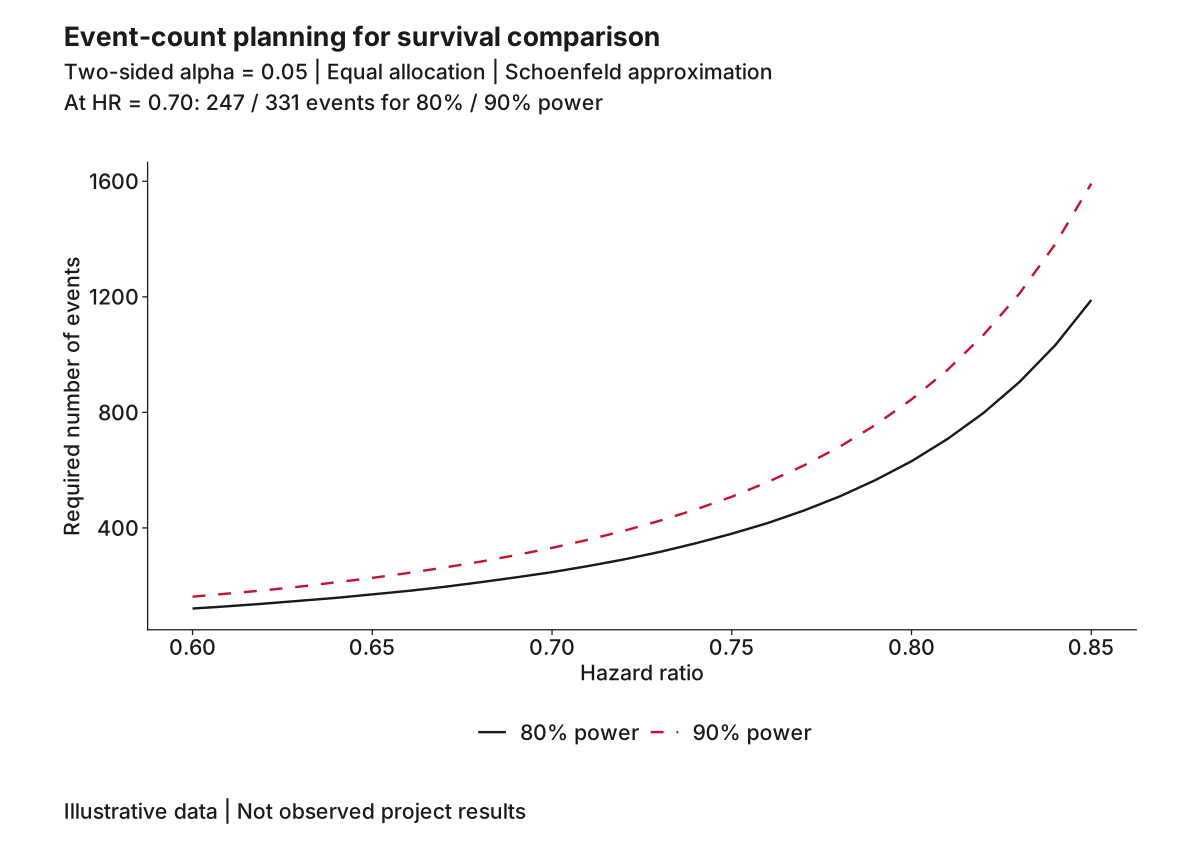
Event counts and power for survival comparisons
Figure 2Event counts and power for survival comparisonsIllustrative data
Figure caption

Calculation example with no observed data. Uses Schoenfeld's event count approximation, two-sided α=0.05, equal allocation to two groups, power of 80% and 90%, and hazard ratios (HR) from 0.60–0.85. At HR 0.70, the required event counts are 247 and 331, respectively. Curves round event counts upwards; event counts are not participant sample sizes and do not yet account for event proportions, recruitment periods or loss to follow-up.

04Clinical Research Services

Study types and design considerations

CRF design and randomisation considerations

CRF field design is central to multicentre RCTs. Each variable needs a defined coding range, particularly for doses, grading measures and time formats, to prevent incompatible data types when centres' data are combined. Stratification factors (usually centre and 1–2 key baseline characteristics) must be specified in advance. An independent statistician generates the allocation sequence, with allocation concealment through a central randomisation system. If interim analyses are planned, an α-spending function (such as Lan–DeMets boundaries) must be prespecified and aligned with the data safety monitoring board (DSMB) arrangements. Intention-to-treat (ITT) and per-protocol (PP) analysis populations must be defined in writing in the SAP to avoid concerns about post hoc changes. A CONSORT flow diagram framework can be prepared at the design stage.

PICOS framework and search strategy design

Meta-analysis design centres on precisely defining PICOS (population, intervention, comparison, outcome and study design), especially outcome and study type boundaries. Whether studies of different designs can be pooled depends on acceptable clinical heterogeneity. Database search strategies (keywords, MeSH terms and Boolean logic) must balance sensitivity (not missing important studies) and specificity (avoiding excessive irrelevant results). Two reviewers independently perform both study screening and data extraction, reporting inter-rater agreement (Cohen's kappa); disagreements are resolved through discussion or a third reviewer. The GRADE assessment framework (directness, precision, consistency, publication bias and limitations) should be specified at design, rather than after analysis. PROSPERO preregistration should be completed early, before literature screening.

05Clinical Research Services

SAP review, registry adaptation and reporting checklists

SAP review and strengthening

The work required depends on the completeness of the existing analysis plan. We can first review whether the SAP covers the methodological elements commonly queried by reviewers (sample size rationale, DAG, sensitivity analysis plans and prespecified subgroups), without starting from scratch. A review report and recommendations are usually completed within 1–3 business days, at a lower fee than full study design.

Registry format adaptation (optional preregistration)

An SAP can in principle support preregistration, but must be adapted to the registry's fields and format. ClinicalTrials.gov, OSF Registries and PROSPERO are study registries, not journals. ClinicalTrials.gov accepts interventional studies (clinical trials) and observational studies; OSF Registries provides preregistration templates for multiple study types; PROSPERO accepts systematic reviews (including meta-analyses) with health-related outcomes, but not scoping reviews. Clinical trial registration timing and journal registration requirements follow ICMJE recommendations and the target journal's author instructions. After the SAP is completed, we can adapt it to a registry format; this is outside the standard scope and quoted separately.

Reporting guideline checklist (self-check / Reporting Checklist)

Item-by-item checks against STROBE (cohort, cross-sectional and case–control studies), CONSORT (RCTs) and PRISMA (meta-analyses) align data collection with reporting guidelines from the design stage. The checklist is delivered in Excel or PDF, in the journal's required Reporting Checklist format, and can accompany submission materials.

Get started · Methodology assessment

Book a methodology assessment

After clients submit their research question, available data and intended outputs, our first response provides methodological feasibility feedback and a recommended package. Reply within 24 hours (business days first), measured in Beijing time; for requests submitted on non-business days, the clock starts at 09:00 on the next business day.

Request an assessmentFree assessment · Quote after assessment